CAUTION:  Contains themes of war oppression child and domestic abuse and bigotry some readers may find disturbing.

The evil began when we all began, so long ago.  But the first time her little child felt it, was when they lost her.  No—after Charlotte, too loving and good for the world she was brought into, was gone.  Little Char had yet to put a name to it, but certainly felt it, and feared it as one fears all unknown dangers:  instinctively.  The instant she arrived, Kynborow, the new Lady Wrathdown, along with her sisters, and their mother Lady Parnell, falling like a dark cloak around Castle Shanganagh, so indecently soon after Charlotte disappeared.  The green had barely yet begun to reclaim the soil over her grave.

The women of his new step-family smiled at little Char, so encouragingly.  The smiles that reached their lips but not their brows.  They seemed to read her secret heart and accept her, in a way even her own mother had not quite done.  And yet some part of the child knew her mother’s love had been true, and her reservations sincere, whereas this affection was not.  Kynborow had been introduced to Char’s father, Lord Wrathdown, by Sindonie, Kynborow’s older sister, a recent widow, who had been placed with them as Charlotte’s lady-in-waiting.  The Lords of Skreen were another of the most powerful families in the Pale, and important allies to the Wrathdowns.  Despite Sindonie’s undoubted competence and commitment to her duties, the then-Lady Wrathdown had not taken her on from personal friendship, and maintained a reserve towards her that something inside Char took note of.

Even before Char’s mother died, Sindonie had come across them:  Char and her mother in their matching silk dresses, eating little honey-and-spice cakes Cook had helped Char to make and serve her mother.  After looking thoughtful for a moment, Sindonie had smiled a secret little smile that was more predatory than friendly.  Without understanding why, Char had known the smile was wrong.  In fact, the knowledge had come not from the character of the smile, which was unfamiliar to the innocent child, but from the slight, sudden stiffening in her mother’s shoulders, a wordless signal that warned her child without either of them even being consciously aware of their primordial communication.  It was good Charlotte who felt the first touch of evil upon her child, and transmitted the feeling as a warning to her daughter on a level deeper than breath itself.

Before that time, her father had paid little enough attention to Char.  He had no interest in children, and children instinctively knew to stay away from him.  He was not evil in the same way as Sindonie.  Or perhaps, the operative fact was, his evil was not interested in Char yet; had not taken notice of her, and therefore had not reached out to ponder her yet.  And in any event, a parent’s evil is always the hardest for a child to see.  Thus it was Sindonie’s evil that first intruded upon Char’s awareness, much like the fearful shiver of a night pedestrian hurrying past a darkened alley.

Though Char didn’t know it, it was Sindonie who had first whispered “popinjay,” a term she had picked up on her travels to London, to the senior Roland, a word the Lord Wrathdown soon began associating with, and using to refer to, his youngest child.

It was not until her mother was gone that the full weight of Sindonie’s and the Skreen family’s insidious evil fell upon Char; or that Char’s innocent young mind grasped what it was faced with.  Sindonie, in her role as one of Charlotte’s ladies, made it her special mission to pay attention to Charlotte’s three surviving children, and care for her youngest.  Char’s surviving two older brothers (their parents having lost four children here on the rough-and-rugged edge of the Kingdom) were Young Roland and Rash Henry.  They had taken a liking to Sindonie from the first time they set eyes upon her; a liking Sindonie carefully encouraged them and everyone else to accept was a natural fondness for the mother of their friend Oliver, a difficult but talented young man about halfway between Roland and Henry in age, who became inseparable from Rash Henry almost from the beginning.

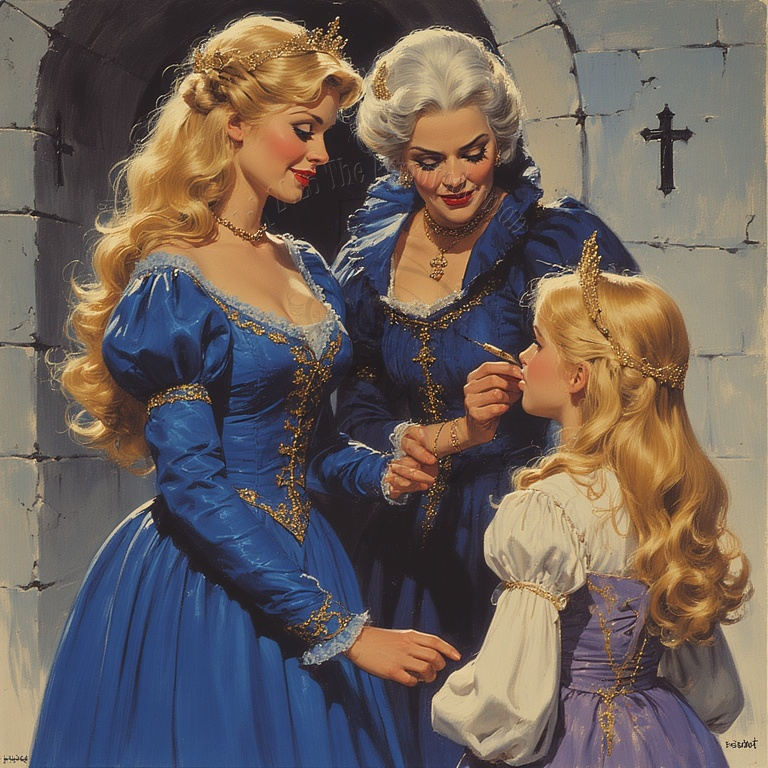
The first artificial blush on Char’s face was put there by Miss Sindonie, to give her wan, drawn cheeks a bit of color for her mother’s funeral.  It was not, Miss Sindonie emphasized, ladies’ makeup; but an herbal tincture to restore her health.  An herbalist herself, Miss Sindonie stood out from her peers (including her own sisters) by her own refusal to wear makeup, which she confided to Char was “compounded by charlatans” from metals and poisons that threw the body’s humors completely out of balance.  Char had not minded the medicine, and indeed would not have noticed how it complimented her delicate features unless Miss Sindonie had taken special care to point it out that evening, encouraging her to refresh it the next morning, and until she started feeling herself again.  Each day, she carefully helped Char with the tincture in the morning, encouraging her with how much better it would make her feel, and how much easier her day would be with the confidence it inspired, until Char would have felt misgivings if she skipped it.  Also, when her father was not around—which was usually the case—Miss Sindonie put Char in one of the dresses that matched her mothers’, and even let her and Cook make and serve honey-and-spice cakes to Sindonie and Edith, listening patiently and encouraging Char to remember how close she felt to her mother, reminding her how special it felt to dress and look like her. 

Miss Sindonie was not one to spare the rod, on Oliver or on Rash Henry or Char, a nickname she herself bestowed on the girl to her face (restricting her own use of the term “Popinjay” to her private conversations with Roland and her own family).  But she was very attentive and even caring, even if a wall of ice surrounded her that never quite melted to anyone except, on the odd occasion, her own son.  Char loved her new nickname, loved the way it sounded and made her feel, a proper girl’s name like her mother Charlotte’s.  And although a part of her remained wary of Miss Sindonie, it sank into subconsciousness because what Miss Sindonie showed her—unlike other adults, who were too busy to do so—was attention and effort, not siblings but certainly cousins of affection.

And Char sensed a related truth:  That Miss Sindonie was genuinely interested in her, in her development, in shaping and influencing her, in making sure she learned certain things properly, like the honey-and-spice cakes:  more than simply mixing and heating the ingredients, but how to flavor them and encourage them with your voice and hands so they made the world a little brighter, the plants greener, and the sky bluer.  Some part of Char knew the delight and pride in her shown by Miss Sindonie when Char cooked and served well was genuine, too.

The first time Char met Miss Sindonie’s sisters and mother was about a month after Charlotte Wrathdown’s funeral, at Kynborow’s wedding to her father Roland.  They giggled and complemented Char and Sindonie on the fine silk, elaborate detailing, and decorations on Char’s gown, and how grown-up she looked compared with the other children in their simple, undifferentiating gowns.  Lady Parnell, with a smirk Char did not quite like, even pinched Char’s cheek and praised how healthy she looked, pausing and emphasizing the word “healthy” with a widening of her cold smile.  Char shuddered, that wintry expression so familiar from Miss Sindonie.  With Miss Sindonie, she had somehow gotten so used to it it didn’t register any more; but recognizing the same expression coming from Lady Parnell and her other daughters struck her all over again, as hard as it had the first time she’d seen it.

Lord Roland Wrathdown treated Char with contempt and a simmering anger that might have been higher since Charlotte’s death, but were not categorically new.  Something even more hostile and cold had passed across Lord Roland’s features when he caught sight of Char at the wedding, but not so unusual it struck Char as odd; and the fact he ignored Char after that, even excluding her from the wedding party, was thoroughly in keeping with his past treatment.

It was not for six months that the unease Char felt for her father’s treatment—an unease she didn’t really distinguish from the overwhelming misery of losing her mother—crystalized into horror, damage, and more loss on Char’s part.  She was too young to even recognize that dread had been in anticipation of something like the storm that finally broke that day in the chapel.

Mistress Kynborow—Char could not even think of her yet as Lady Wrathdown—disappeared with Lord Wrathdown for a fortnight after the wedding, not to be disturbed (as if Char would want to see either of them).  Soon after they resurfaced, Lady Wrathdown commenced holding court on a more-or-less daily basis with the other gentle women of Wrathdown who lived close enough to Shanganagh Castle they felt safe traveling to it.  Predictably, most women who could persuade themselves to feel safe, came to mingle with the Baroness regardless of the actual risk.

Their daughters over seven, and well-behaved children like Char and a couple of the girls, were allowed, and therefore expected, to join them for embroidery, games, and of course prayers, when not in the castle’s Dame School with Miss Sindonie, who had taken it over upon her sister’s arrival.

“I miss my father,” Edith admitted wistfully, at one such gathering, about six months after the wedding.  “And I worry about him.”  She had moved to an arrowslit on the South wall, which served as one of the chapel’s windows, and was peering down at the Bray Road below trying to see the horsemen they had all heard clattering past.  The arrow slits, being cruciform, were in a way quite appropriate for the chapel, which was being used as a makeshift classroom for the petty school students aged 4-7 when it wasn’t being used for Lady Wrathdown to hold court.

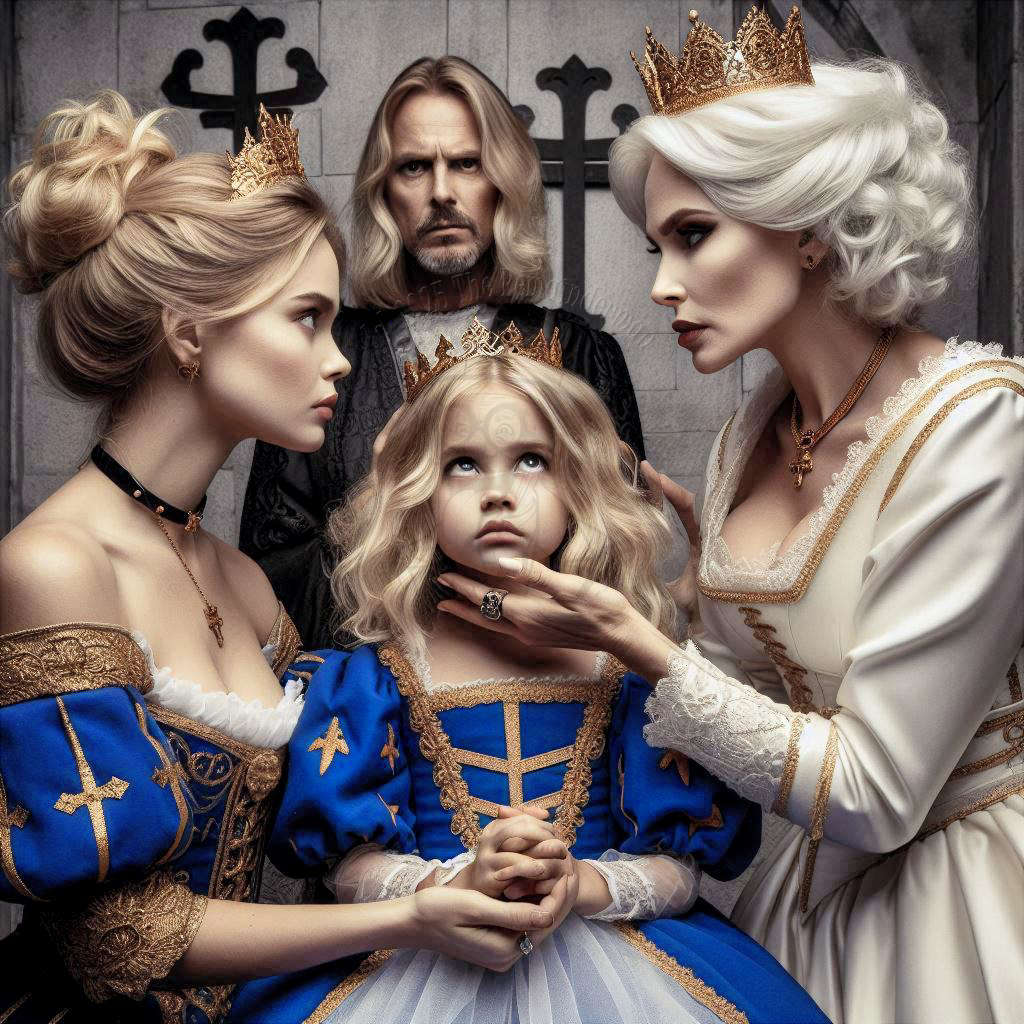
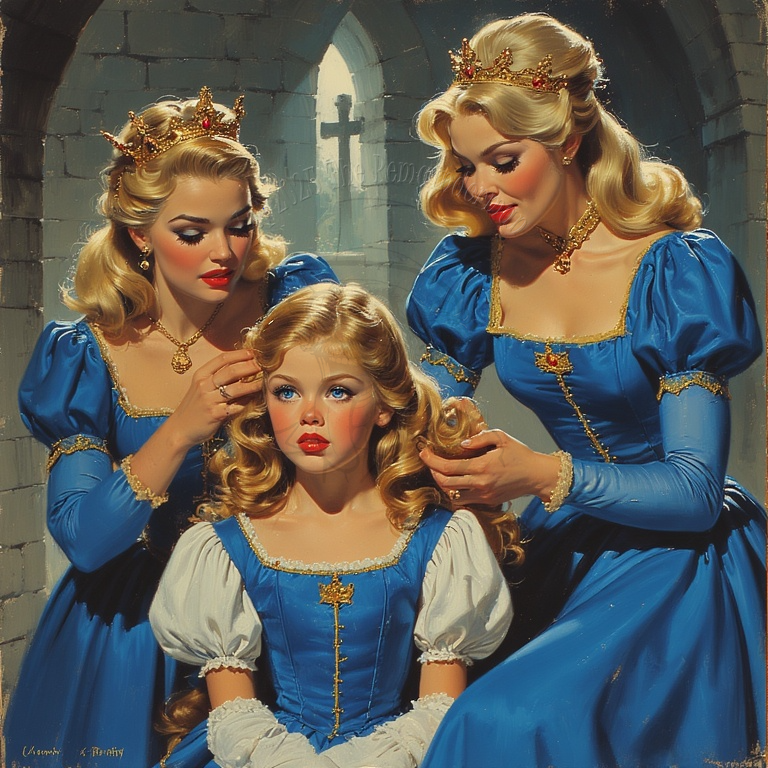
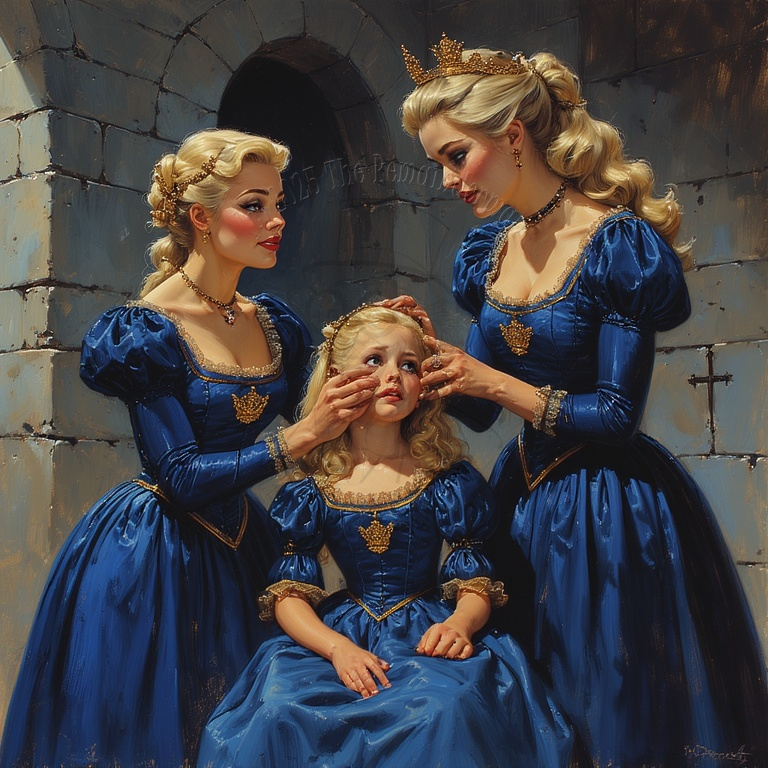
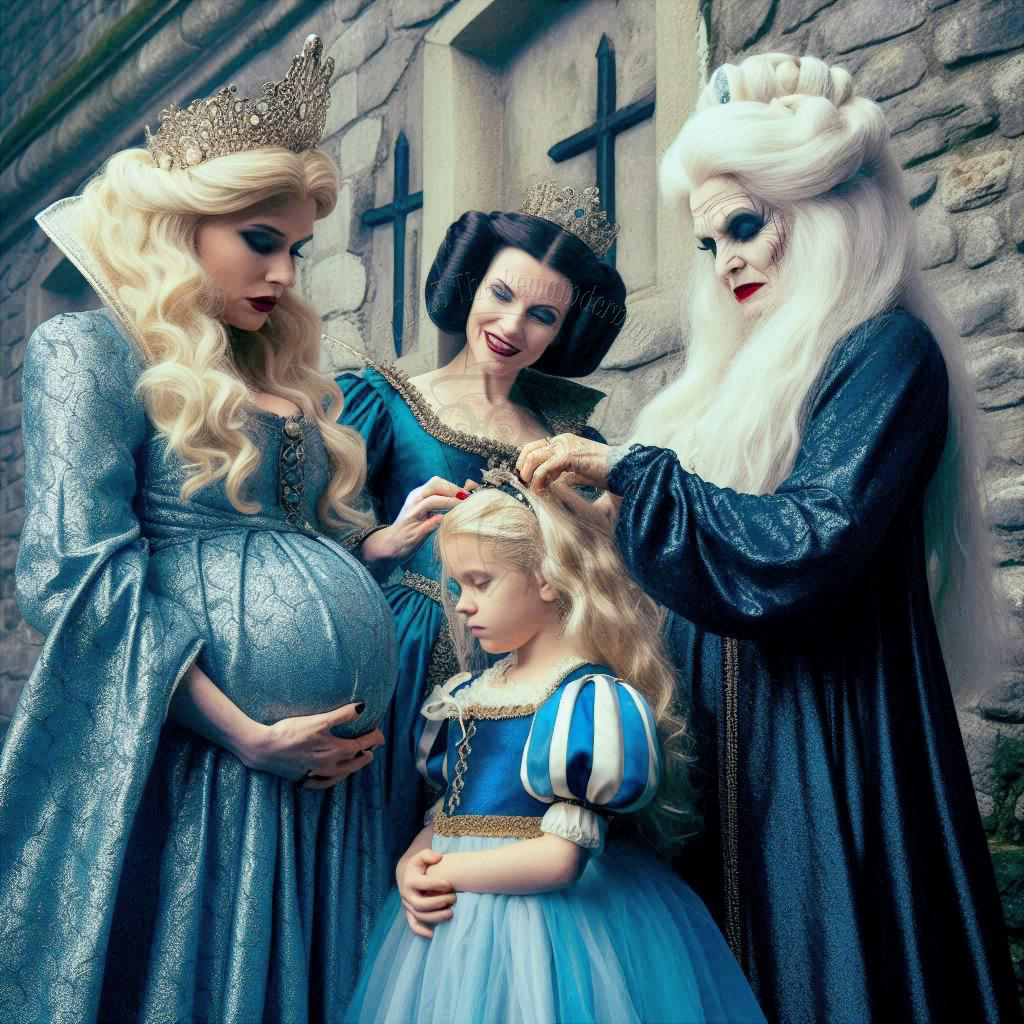
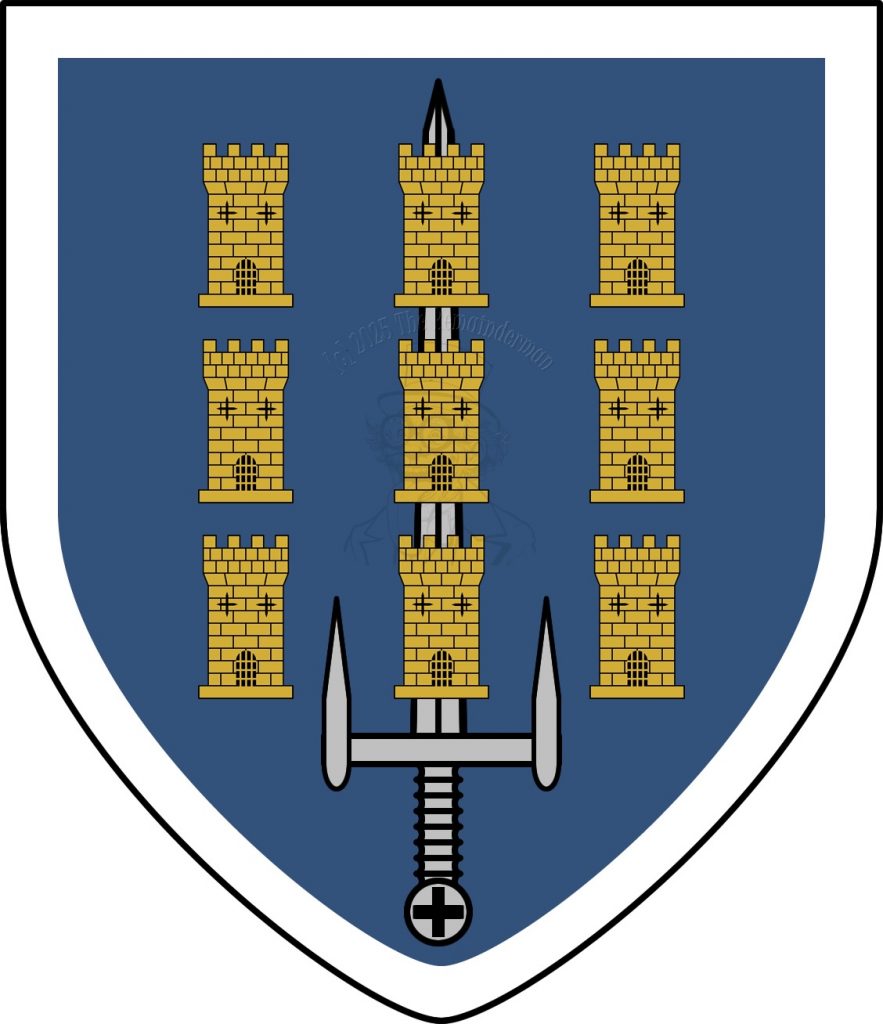
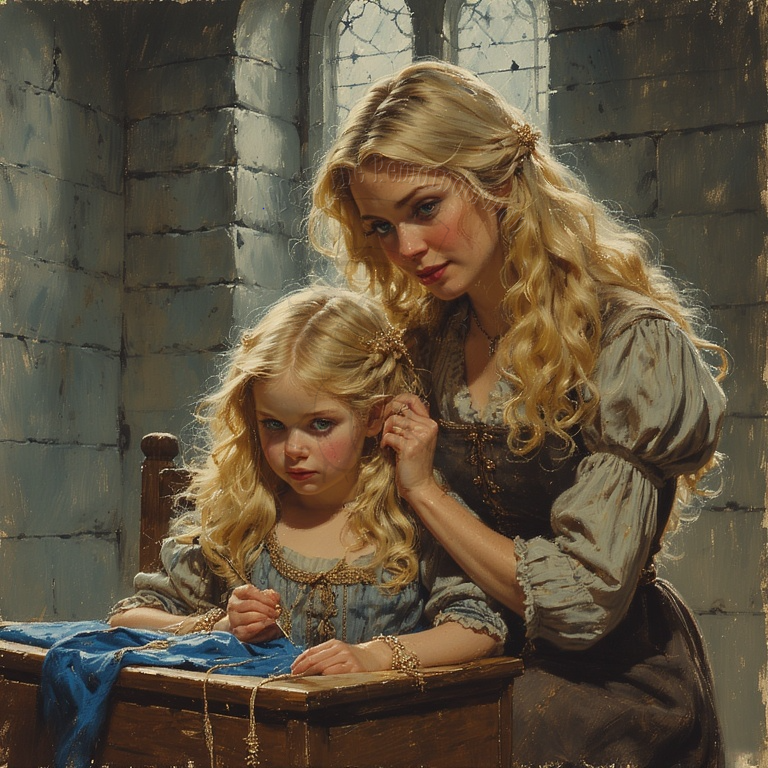
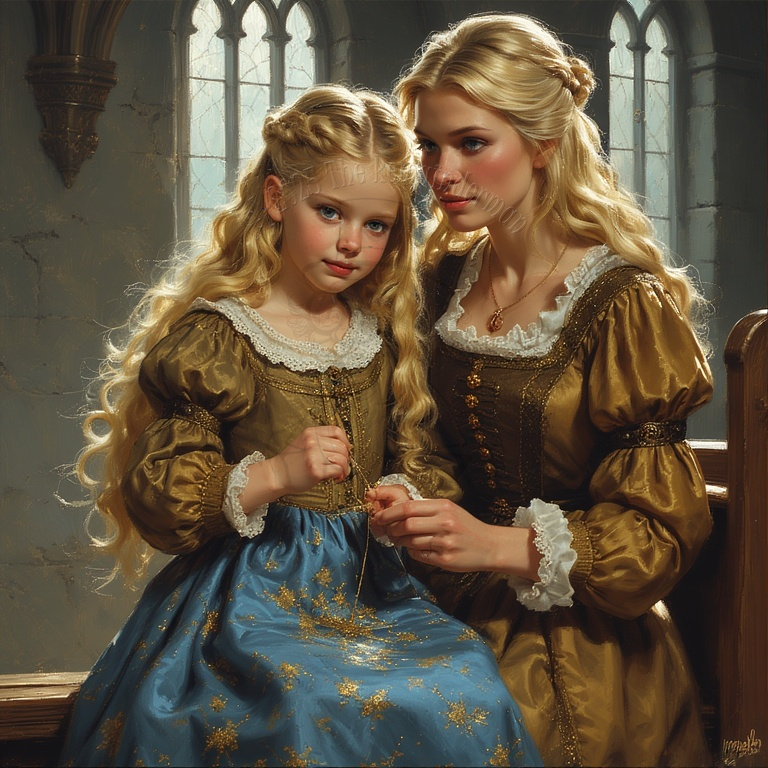
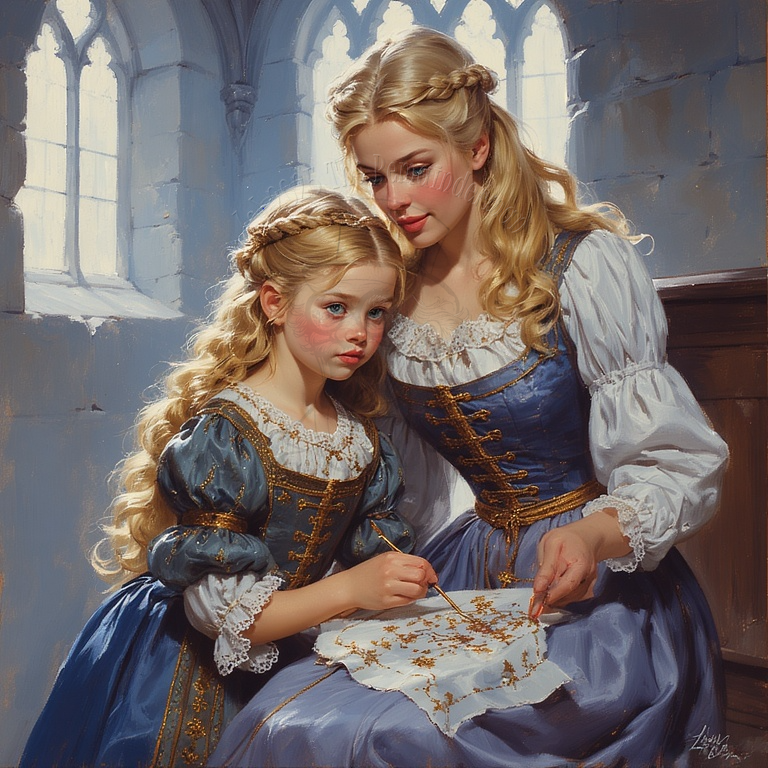
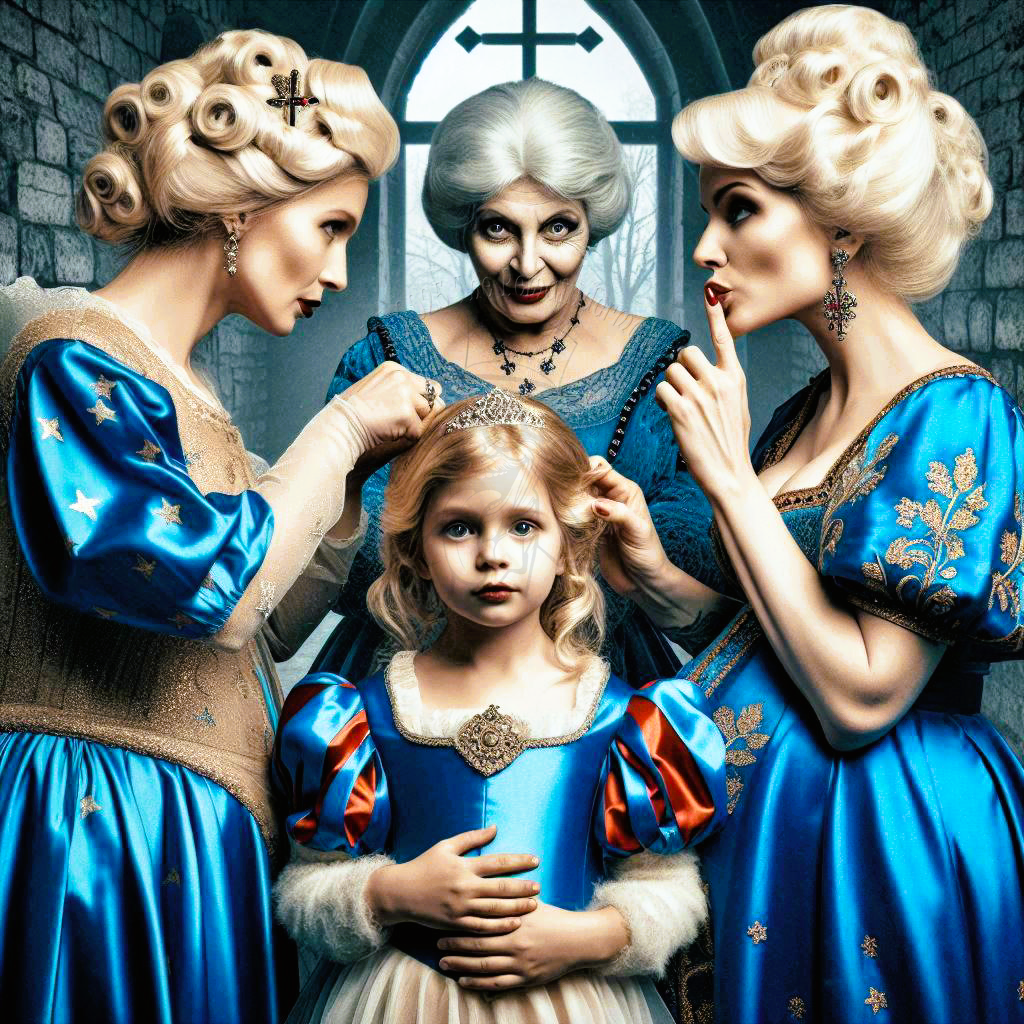
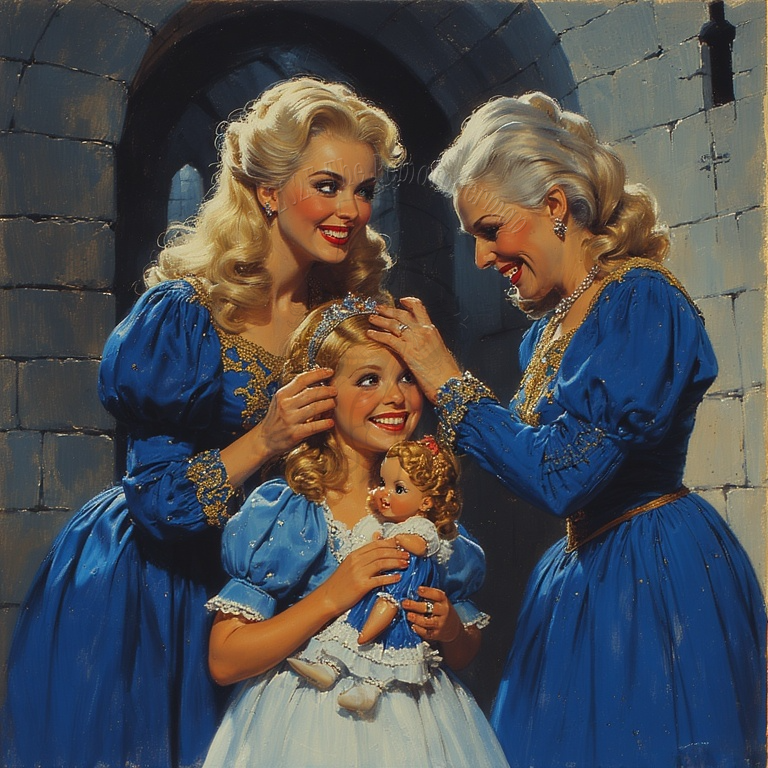
Edith and her friend Char were embroidering their Lord’s banner together, working on a magnificent bolt of blue silk from China.  Char was using fine golden thread to embroider a castle, one of nine on Baron Wrathdown’s coat of arms, while Edith was using fine silver thread to embroider the raised sword beneath the three castles in the center column.  As they did so, Edith’s mother, Char’s stepmother, and their teacher SIndonie, were gossiping and brushing the girls’ long hair. 

Char was sitting with one thigh over his stepmother’s leg and her bottom on Miss Sindonie’s lap, as she had been for most of the morning.  The women liked to keep her close, their hands on her waist or hips, even at an age when other children were beginning to separate a bit more from their parents.  Lady Wrathdown was so hugely pregnant, her lap could no longer accommodate Char.  They said her baby had grown quickly and could come any day now.  When Friar Hugh was teaching, Miss Sindonie often acted as surrogate stepmother.

The other ladies of the half-serjeanty sat around them with their daughters, working on projects while the children’s tutor, Friar Hugh, an Augustinian who assisted Sindonie with the children’s Latin and religious studies when he was in Wrathdown, wrang his hands and tried to decide how quickly he could excuse himself to chase down the rest of his students—the women’s sons, the girls’ brothers—who had bolted excitedly from their lessons to see what all the racket was about.  The clergyman couldn’t quite mind their absence for a bit; they bleated and fidgeted like excited goats.  Girls might not have the intellect for learning, but they certainly had the superior manner.

“I want my father to come back,” Edith frowned.

Char responded matter-of-factly, “I don’t,” provoking a dutiful tutting sound of disapproval from her stepmother and step-aunt, and a satisfied smirk from her step-grandmother, Lady Parnell.

“Your fathers’ work is important!” Friar Hugh reminded both of them, presumably intending to comfort or reconcile them to the situation in some way.  “All Ireland is divided into three parts:  Gaelic, Norman, and English.  The wild Irish savages have overrun most of the North and West, and unfortunately, the wilderness just to the South of us, while the King has been focused elsewhere.  Most of the ancient Norman lords, themselves bastardized by their time in this godforsaken land—”

“Sir!” Miss Kynborow laughed, scandalized, pausing in her hair-brushing to put her hands over Char’s ears.  Her ladies laughed with her; and their daughters, according to their age and disposition, either smiled uncertainly or looked nervous.  “We are the source of civilization here.  We must set an example!”

“Quite right, Lady Wrathdown!” Friar Hugh agreed, as if she had been confirming his point rather than criticizing his language. “The Norman Earls beyond the Pale—they’ve become more Irish than the Irish, lacking all appropriate devotion to Ireland’s proper Lord, our blessed King Henry, designated to rule here by the Pope himself!  They aren’t reivan’ and raidin’ us like the Irish sinners, but they aren’t loyal, either!  Only we, the good Kings’ men of the Pale, the land behind the wall, the Lordship of Ireland, defended by your fathers, are the lone outpost of true English culture here!  Your fathers’ work defending the Church and law and order is the work of King and Christ, children!”

“Yes, sir,” the children dutifully responded, exchanging meaningful looks expressing their fervent hope his speech would not inspire another lengthy prayer begging God to strengthen their fathers’ hands against the murderous clans to the South.

But Friar Hugh was going in another direction, shaking his head, lost in thought:  “Beyond the Pale it’s all chaos and cannibals—”

Edith gasped excitedly.  “Cannibals!”

Thank you, sir,” Lady Kynborow gave their priest a significant look.  “I think that’s enough on that topic.”

Friar Hugh tried without success to look convincingly distressed.   “Yes of course, Lady Kynborow.  I just meant, they’re barbaric!  They don’t even wear shoes!

The girls giggled, while Lady Kynborow’s mother, Lady Parnell, muttered:  “No need to mind your language on our account, Father.  There’s not a child in Shanganagh Castle left with tender ears,” provoking more giggling from the older girls.  Wrathdown was shaped and practically defined by its role defending Dublin against perennial Irish raids from the Wicklow Mountain country.  It had a rough-and-ready martial character that preceded, but certainly could not eclipse, its present Lord, who practically personified the Norman warrior ethos of old.  The force of his personality had imprinted itself on every male in the castle and the countryside alike, and even attracted a number of rugged young adventurers from England and elsewhere to try their hand against the Irish.  It helped in recruiting that there were more manors than knights here on the border, available to anyone with the wit and strength to secure a hold for themselves in the name of the Pope and the King.  Even in a man’s world, the Irish frontier was man’s country in 1516, with women living on the margins of daily life.

“Mother!”  Lady Kynborow repressed a smile.

“Don’t pretend otherwise.  Char’s muckspout father—”

As if to make her point, at that very moment Baron Roland, Lord of the Half-Serjeanty of Wrathdown himself, threw the door open hard enough for its hinges to rattle and the latch to chip off a bit of stone from the wall of the small castle.   Very much a Marcher Lord, wielding a real and direct military power that most English barons lacked to prosecute his King’s war, the Baron maintained nine front-line castles shielding Dublin from the depredations of the Irish natives to the South, all connected by earthen barrier walls running from the Irish Sea at Wrathdown Castle to the border with Uppercross past Templeogue Castle.  They imposed a significant burden on the modest revenues of the Serjeanty, even with the subsidies he received from the viceroy’s Dublin Castle administration. 

So it was hardly surprising the castles were compact, efficient, and coarse, combining the functions of defense with those of daily life.  The chapel, occupying the third floor of the small castle, was used for everything from mass to feasts to rare tax-exempt markets and classes like this one, especially in warmer months when the welcome light and fresh air provided by the third-story arrowslits compared most favorably with their drawbacks in winter, a time when they were usually filled with loose bricks.  The ground floor was the great hall where they slept and ate and even cooked; and the second floor, Lord Wrathdown’s private chambers, storerooms, and utility rooms.

The Baron’s impromptu retinue, the excited boys of the castle Friar Hugh had been fretting over, swarmed back into the room, swirling around the Baron and his companions like a Huntsman’s dogs howling and barking in excitement while dodging the hooves of angry stallions.

“God’s light!  Finally!  Here you all are.  I practically ransacked the castle.  What divine office are we celebrating mid-afternoon?!  We thought the damned savages must have taken the lot of you!” 

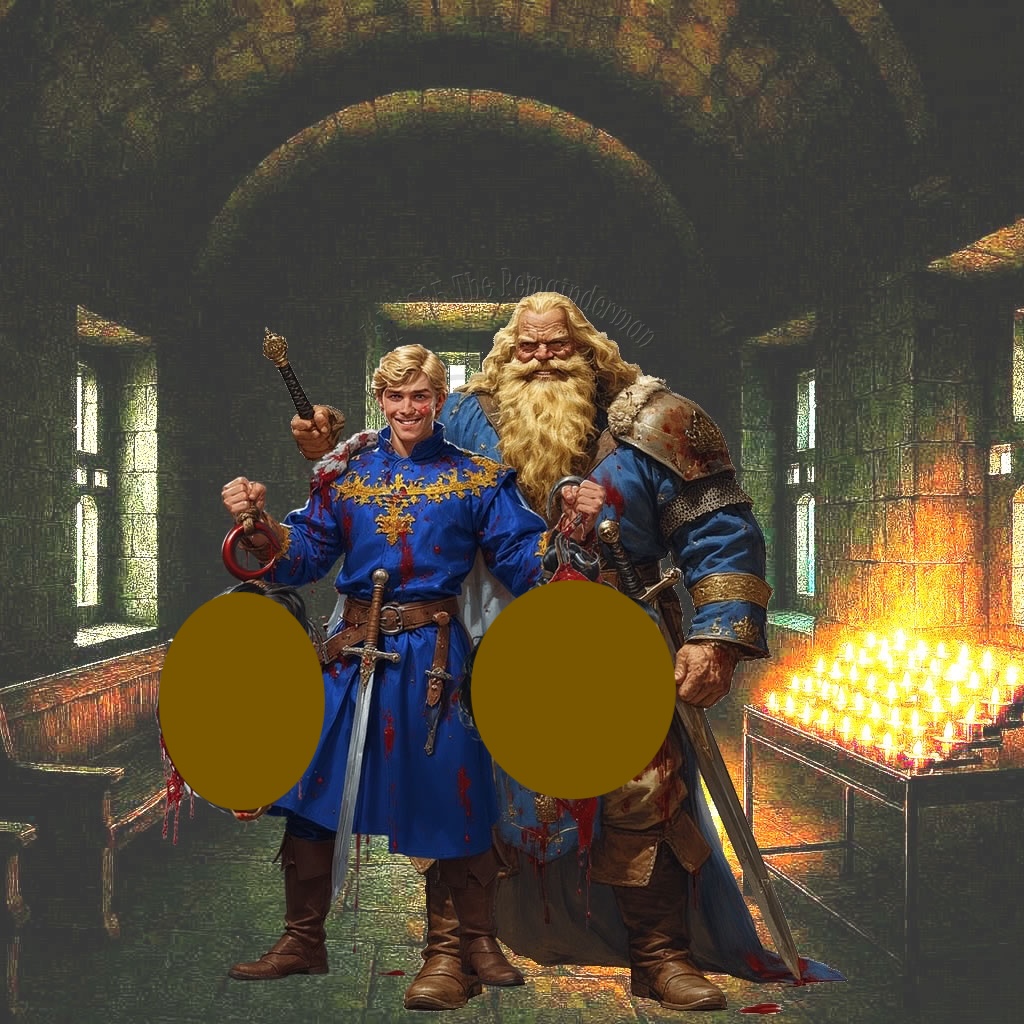
Lady Parnell directed a look at her daughter as if the obvious had been revealed, but otherwise there was little enough room for anyone else when Lord Wrathdown took the stage.  Stinking of smoke, sweat, and offal, his clothing and skin were stained and spattered reddish-brown with dried blood, the clean patches of his head and chest revealing where he had removed his helmet and cuirass upon entering the castle. 

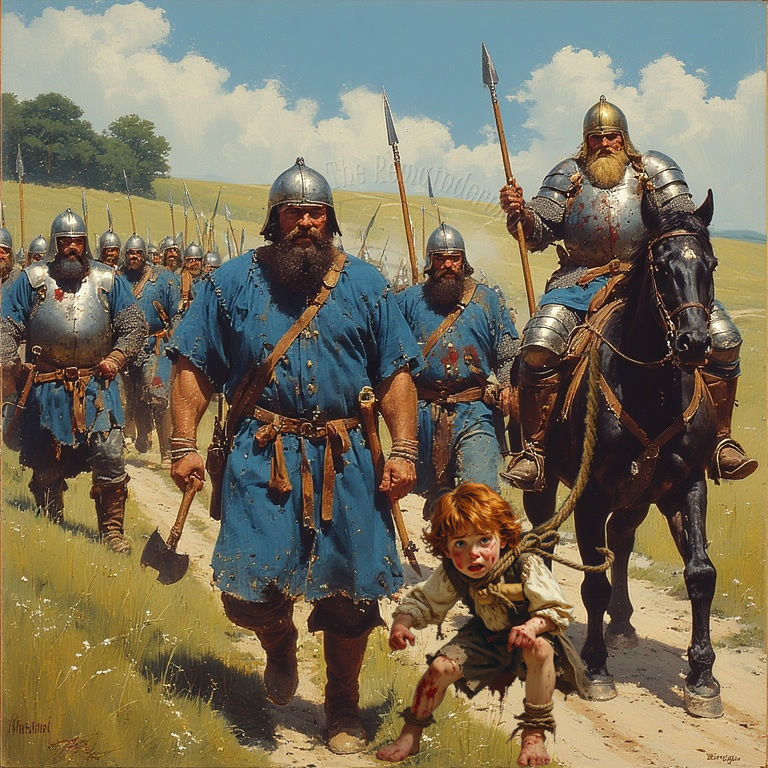
“Papa!” Edith cried as her father, Sir Ambrose, entered behind his Lord, thwarted in her attempt to hurry to him by her mother, who hugged her tightly.  Sir Ambrose was half-leading, half-pulling a copper-headed, dazed-looking barefoot boy of about 5 or 6—Char’s age—in a gown behind him.  Both of them were as bloodstained and filthy as the Baron; and the boy’s air of detachment and lack of focus were only reinforced by the contrast he made with the intensely involved and overstimulated castle children.   Edith’s father smiled encouragingly at her, but with a gently raised palm, urging her to wait.  No adult in the room imagined it a good idea to compete with their Baron for attention.  And in fairness, the man was larger than life, well over six feet tall with broad shoulders, strong arms, and an impressively-long beard demonstrating his virility.  His personality was as loud and brash as his speech.  Edith’s father could not have competed with that if he’d been of a mind to; and he was far too sensible to have any such thing in mind. Only three of Roland’s half-brothers, half of the children of his father’s first wife, had survived childhood.  One, it was rumored, had gotten in the way of Roland’s ambition and died gruesomely.  A second, eager to stay out of his way, had joined the church.  The third, and eldest, was an Earl of the family’s main estates in England, and doubtless hoped Roland’s inheritance in the Pale would keep him too busy to come after him.

The last member of their party to enter, marked with the same stains and smells as the other three, was Young Roland, the Baron’s firstborn son, unmistakably of a piece with the Duke himself, Char, and Rash Henry (wherever he was):  Every member of the family’s hair, on both sides, shone a blazing yellow-gold.  Theirs was the hair of lions, not just yellowish, but a strong, saturated hue that made other shades of yellow look washed-out or dirty.

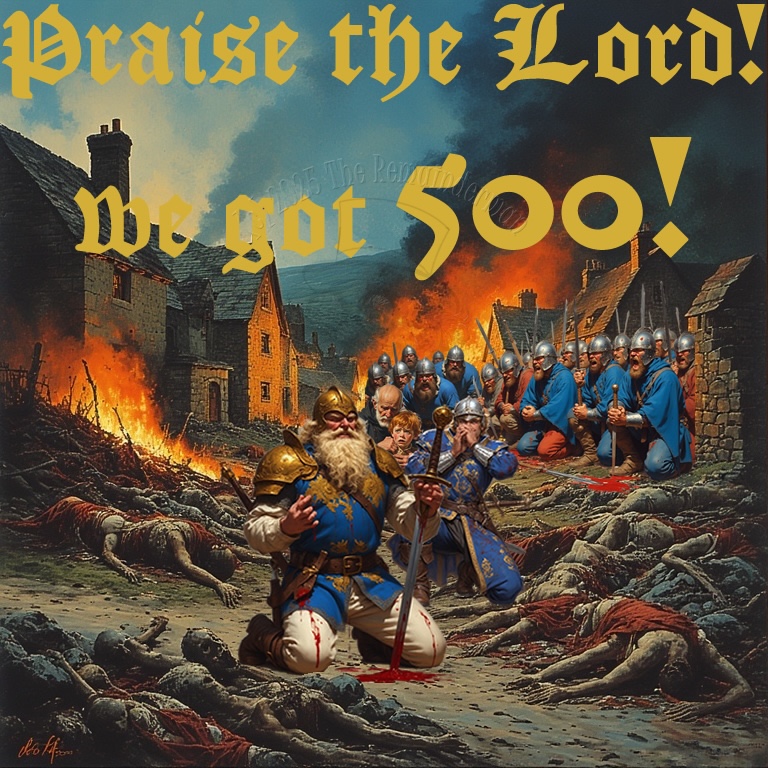
“Yesterday was a magnificent day!  We caught half the damned O’Tooles, and the O’Byrnes too!  Out looting and burning in Bray and Shankhill.  I collected six Irish heads!” he roared proudly, gesturing impatiently at his son.  “Show ‘em, lad!” 

Char and the ladies cried out and recoiled in horror as Young Roland, grinning proudly, held up two strings of four heads each, with their hair braided and bound together with rope like obscene cloves of garlic.  “I got two of my own, Stepmother!” he boasted enthusiastically, smiling so proudly she felt obliged to smile back at him with the same enthusiasm a peasant woman would greet a housecat returning with a dead mouse in its jaws.

“That’s nice, dear!” she applauded, doing her best and elbowing Char, who, jaw set and arms crossed, ignored her.  “Isn’t that nice?”  And when ignored by Char, pressed her husband:  “God bless you on your victory, my Lord!”

He rumbled angrily.  “More of a draw.  But it was a glorious, unholy bloodbath!  The manor of Raheen-a-Cluig’s a goner.  The men of the village were strung up and cut up into ribbons, and the women and children who weren’t raped and butchered were taken by the O’Byrnes.”  Neither Lady Kynborow nor anyone else in the room thought about chiding the Baron for his language. “Lost for good up in the mountains.  But it wasn’t all bad, we left the dirt soaked with their tainted Irish blood, and caught a few slaves for the lead mines.  Oh!  And here, give me the lad!”  Roland gestured to Ambrose, who gently nudged the dazed boy toward his Lord, who in turn, seized his arm and yanked him forward.  “My knight and his wife were dismembered with the rest of the manor in most grisly fashion, must have screamed for hours!  But this one hid.  Or, more like, the Irish just didn’t want anything to do with this odd fellow.” Roland shook him slightly for emphasis to make sure Parnell and Kynborow understood who he was referring to.  “Their son and heir.  He’s my ward now, and in addition to bringing me his rents, the parish priest in Bray says he’s a sage in the making.  That note’s for you, Father,” Roland jabbed his finger toward a reddened scrap of paper pinned to the collar of the boy’s robe.  “He’ll be a perfect tutoring companion for that worthless son of mine, who wasn’t with the rest of my wild dogs—” he gestured vaguely towards the boys tripping over themselves to follow him around.  “Where is that Popinjay?”

Something in Kynborow’s guilty expression must have alerted the Baron to the truth because his eyes widened and bulged out, his face turned a mottled purple, and he bellowed:  “My son?!  You’ve got my son there brushing his hair?”

Young Roland guffawed nastily, and even the unfortunate orphan blinked twice, the closest thing to an expression of any kind, facial or verbal, he seemed able to muster, as Lord Wrathdown dumped him unceremoniously onto an empty pew and barked “Shut up!” to his eldest.  Nobody else in the room required such a caution; not one of them, not even the stupidest of the castle boys, dared meet the Baron’s eyes, let alone make any sound that might catch his attention.  “He’s SEWING?!?!  MY SON is SEWING with the women of the Castle instead of playing with his friends?!

These are my friends!”  Char murmured, ducking his head and shrinking back into Kynborow even as he spoke.  “not them!

“Please, my Lord!”  Kynborow—having no way to avoid her husband’s attention—pleaded. Because she and Miss Sindonie were behind her, Char couldn’t see their expressions; and the Baron was too distracted to pay any attention to them.  But although Kynborow was doing an impressive job keeping her face in character with a distressed woman, every bit as well as she was going to lie, Sindonie’s face betrayed the faintest hint of a smile despite her best efforts to suppress it.   “We’ll bring her—I mean, him—along, but we want to keep him as his mother made him for a little while longer, to comfort him.  He’s only lost his mother last winter—we want to give him some time to recover and grieve before we bring him into our family!”

SEWING AND PLAYING WITH GIRLS?!  The Baron Wrathdown’s SON?!  NEVER!!!  NOT FOR ONE SECOND MORE!!!”  Baron Roland roared, his face turning purple and wrathful while veins bulged alarmingly from the sides of his neck.  “Clearly he’s better off with her dead!

His attention was distracted back to his son as Char burst out crying:  “I’d only be better off with you dead!”

HOW DARE YOU?!?!  Not just a woman, then, but your sex warped back again into a shrew?!  What’s wrong with you?!”  Lord Wrathdown thundered incredulously.  “God, and therefore Wrathdown” (it was unclear here whether, having taken the Lord’s name in vain, he was referring to himself as the Baron, or taking it upon himself to speak for the entire half-serjeanty) “will not tolerate such an abomination as a baedling!  I’ve got to STOP THE ROT for the sake of our family!”  Roland growled again, wading forward to tear the child forcibly away from his stepmother, throwing him down over a pew and thrashing him with the flat of his blade—cleaner than his own flask, and doubtless the only thing beside his horse and other weapons Lord Wrathdown had made sure were tended after the battle—while the Skreens wept crocodile tears,. Miss Sindonie, her eyes glittering cruelly, held Kynborow back, and every other woman in the chapel started shrieking.  Even Friar Hugh murmured nearly-audible protests, waving his hands ineffectively as he considered whether and how he dare intervene.  Continuing to wallop mercilessly on poor Charles’s bottom, the Baron continued his diatribe:  “We’ve got to get you away from the evil influence of these damned women!  You’ve clearly been coddled and indulged by women long enough!”

“No, please!”  Kynborow wept convincingly, as the Baron’s arm rose and fell, rose and fell, over and over again, on his bawling, kicking, crying child.  “Please, Roland!  Surely that’s enough?!”

NOTHING’S enough for a son of Roland Wrathdown who sews and brushes his hair like a woman!”  It almost sounded like Lord Wrathdown was weeping with his frustration and rage, his eyes filled with the same aubergine fury that stained his face and every inch of visible skin, as spittle flew out of his mouth.  “No son of Roland Wrathdown plays with girls instead of boys!  I thank the lord he gave me six my other good and manly boys before this one was sent from hell to disgrace us!”

Lady Parnell and several other women were trying to restrain the hysterical Kynborow who was screaming and crying and trying desperately to protect her stepson, while Sir Ambrose and Friar Hugh edged nearer to the Baron with their hands raised placatingly, ineffectively trying to encourage the Baron to stop.  Behind them, the red-haired boy sat still and slumped where the Baron had dumped him, staring listlessly toward the altar with his unfocused, haunted sapphire eyes, showing no interest in—or even awareness of—the maelstrom around him.

“And YOU!” He jabbed his finger towards Lady Parnell and her daughters, startling them.  “You can stay to help my Kynborow with the birth but as soon as my boy is born, YOU—” he poked his finger into Sindonie’s shoulder, “and YOU—” he pointed his finger rudely at Lady Parnell, “AND you!” stabbing toward the youngest sister, Thomasin, “Return to your own Lord in Skreen!  I won’t have you poisoning my next boy!”

“What if it’s a girl?”  Kynborow asked, perhaps before thinking better of it, but only thinking whether they might be allowed to stay in that circumstance, instead of leaving her here alone in this masculine demesne so far from Skreen.

“Then I’ll blame YOU for breaking my perfect record of boys!” Roland roared, so focused on his own concerns he couldn’t imagine any of his wife’s. 

“If I thought he was man enough, I’d squire him to Lord Nethercross, he’s a hard man!  But this prating grovelsimp is already RUINED!”  Lord Wrathdown’s eyes widened, as he hit upon the solution to his remaining problem:  “None of our family have gone for the church in generations—only our money.  It’s time to recoup on that investment!  I’ll send him, to live among men, and eradicate every bit of female weakness!  AND he won’t corrupt our blood by breeding!”

“We would be honored,” Friar Hugh assured him eagerly.  “In a year or two, when he’s ready—”

ARE YOU LISTENING TO ME?!”  As if any of them could fail to do so.  “Not a year or two.  NOW!  Before he becomes a full-on eunuch!”  Lord Wrathdown growled dangerously, turning his attention to the terrified Friar Hugh.  “Get away from me, you worthless fopdoodle!” The Baron struggled to find words, flinging his bawling son away from him without even letting him catch his balance.  “I can’t stand to touch you right now!”  Instead of walking, Char careened several feet across the stones and fell onto the lap of the orphaned boy, who absentmindedly folded his arms over Char and began rocking him gently and patting his back, repeating “there, there” without even looking down in a mechanistic way that was much creepier than his dazed silence had been.  Char shrieked and wailed, burying his head in the boy’s lap and hugging him tightly back, kicking his own legs in a desperate gesture to discharge the intense emotions and physical pain that were overwhelming him, threatening to swallow him whole.

Lord Wrathdown looked askance at the orphan a moment more, then shook his head.  “Smart or no, there’s something badly wrong with that one.  But that makes two of them.  And they seem well-matched.”  Nodding and shrugging, he looked at Sir Ambrose.  “And at least he is male!

“Certainly true, Lord Roland,” Sir Ambrose agreed.  “A perfect companion!”

“You’ll take them both, father!” Lord Roland barked, deciding it on the spot.  “Today!  Take him to that—choir school I sponsor at Christ’s Church!” 

“Oh, good, they can… sing, Your Lordship?”  Friar Hugh asked, sounding as reasonable as a canon lawyer but cringing all the same hoping the question would not provoke Lord Roland.

Apparently Friar Hugh had no such luck in store.  “DOES IT MATTER?!”  Lord Roland demanded loudly.

“Not at all,” Friar Hugh assured him, backpedaling, “only, it’s just, Father Luke, the Choirmaster, is quite the martinet, he runs the choir as a tight ship, likes to try out and hand-pick the boys himself—”  Everyone other than the Baron could see how conflicted and agitated Friar Hugh was, swallowing and practically wringing his hands with anxiety as he considered his position, how to explain his actions to his superiors if he turned up with two underaged no-talent boys, trying to insert them into another friar’s choir and school when doing so would interfere with the progress of the rest of the class. 

It would surprise exactly no one in Castle Shanganagh to learn Father Luke had been the newest and lowest-ranking member of his order in Ireland when he was assigned as the tutor to the nobility and gentry here.

Even as Roland began turning his head to fix his eyes on Friar Hugh, Friar Hugh achieved the breakthrough he urgently required, bringing his deliberations to their speedy and vitally necessary end, babbling:  “Actually… not at all.  Of course not.  It doesn’t matter at all, Your Lordship.  Everyone can sing!  I mean, everyone has a voice.  And of course, Father Luke will be so thrilled to have another of y—to have such a high-bred young man and his—er—” Luke had no idea what to say about the orphaned boy, knowing only that by birth, he was a member of the gentry.  But after all, that was probably enough:  “His gentle companion, er—ah, thank you, My Lord, thank you for—for entrusting them to us.”

“That’s better,” The Baron allowed, his eyes widening with pleasure to see the unmistakable lust on at least Kynborow’s—and Sidonie’s—faces.  Kynborow was still crying, speaking no words but now begging him for something different with her eyes.

“Fuck!” the Baron rumbled, adjusting his codpiece. “After yesterday’s battle… and you’re carrying our little one…. This is my point!  Your sympathies are misplaced!  A woman wants a real man!  Coddling the little ponce won’t serve him in the long run.  Come on, we want our child to be vigorous and healthy!”  he urged her, pulling Kynborow against him, rubbing his crotch against hers, and stroking her breast without a thought to subtlety.  “Ah… Help your sister, Sindonie,” he breathed raggedly, eyeing his sister-in-law, before pulling his attention back to his wife and his wife towards the stairs to their bedroom below.  “It’s practically a duty!  Come, welcome your Lord home from battle properly!”

Literature Section “08-01R REWRITE The Pustlular Bloom of Evil”—more material available at TheRemainderman.com—Part 1 of Chapter Eight, “The Wild, Wild West”—about 2134 words [5450-3316=2134 additional words]—Accompanying Images:  3605-3616—Published 2025-12-30—©2025 The Remainderman.  This is a work of fiction, not a book of suggestions.  It’s filled with fantasies, stupid choices, evil, harm, danger, death, mythical creatures, idiots, and criminals. Don’t try, believe, or imitate them or any of it.
PREVIOUSLY:  Two traumatized boys of 5 or 6 residing on the militarized Southern border of the Pale have just been given into the care of the Augustinians:  Char, youngest son of Lord Wrathdown, a finicky mommy’s boy and a bit of an airhead, has been banished to the Church to make a man of him; accompanied by a new ward of his father’s, the refugee of an Irish raid, who was meant to help him learn, but is still in a state of shock from whatever he has experienced there.  NOW:

“I don’t think I’ve ever been so far from home before!”  Char broke his silence in wonder all of ten minutes and a third-mile from Shanganagh Castle; and once he did, the dam was well and truly broken.  The thoughts seemed to go racing straight from his brain to his mouth in a continuous flow like the water of the Liffey River.

“Really?” Friar Hugh asked in surprise.  “Probably for the best, in an area as wild as this.”

“Lady Parnell doesn’t like any of us to wander far,” Char nodded, explaining:  “There’s Irish savages everywhere.”  And then added proudly:  “I’ve seen them.  One of them even talked to me!” he admitted in a scandalized voice.

“Why?”

“He was on the road and asked what the castle was named.  I’m not supposed to speak to them, but he seemed human enough.  Except I could hardly understand him.  Even his English sounded Irish.”

“Did you tell him?”

“Yes,” Char admitted.  “I didn’t want to be impolite.”

Friar Hugh, covering his amusement, asked:  “And were there any ill effects?  Of speaking to an Irishman?”

“There were.  Lady Parnell was furious and smacked me on the mouth as a reminder not to use it with Irish.”

“Right,” Friar Hugh answered wryly.  “Cause and effect it is.”

Rubbing his jaw as if to evaluate the spot, the child said:  “I miss my mother.  Ladies Parnell and Kynborow don’t like me,” he observed matter-of-factly.  “But they aren’t nearly as bad as my wicked father.”

On a typical day, Friar Hugh might cuff a child for speaking ill of his parents; but he was trying to be mindful the boy’s whole life was changing unexpectedly today.  The vulnerable, emotional quaver that frequently modulated Char’s voice helped to remind Friar Hugh of that.  And, of course, in the case of Char’s father, it wasn’t disrespect so much as a simple statement of fact.  The Wrathdowns and their ilk were among the most-notorious families in the Pale, and Lord Wrathdown was worst of the lot.  Except, perhaps, the Shambler of Hell—although he was not a Wrathdown per se, he was one of the ilk and a terror in his own right.   

By the time they were a half-mile from Shanganagh Castle, Char’s voice sounded like a cross between amazement and boredom:  “Are we still in Wrathdown?”

“Aye, until we pass Castle Dundrum and a bit.”

“It’s so big!  I knew there were nine castles, but we haven’t even seen another one yet!” 

Friar Hugh laughed out loud at that.  “Not so very big.  Carrickmines and Dundrum are the only two you will see today, on the road to Dublin from Shanganagh.  After Dundrum, we’ll leave the Pale behind us.”  Char, and presumably the other boy, understood Friar Hugh was referring now to the earthen battlement and ditch itself, that stretched between the frontier forts around the English territory and gave it its name, rather than the region within it.  “Dublin’s in the middle, of course.  Your young friend came from around Keen Bray Castle, at the very Southernmost tip of Dublin County, and of the Pale.  Probably, I don’t know…” Friar Hugh mused “Ten or fifteen miles South of here?”  

“Fifteen miles?!” Char exclaimed.  Then asked:  “Is that far?”

“Not so very.  Much further than we’re walking today, though, so no complaining.”


“What’s his name?” Char asked suddenly, frowning at the other boy with curiosity.

“Pendragon… Pendragon…” Friar Hugh consulted the paper from the boy’s chest.  “Pendragon Argent.”

“Pendragon,” Char repeated carefully, evaluating the boy and asking “You’re named Pendragon?”

The boy said nothing.

“He should answer me when I speak.  I’m his superior!”

“He’s had an even worse day than you,” Friar Hugh pointed out.  “Perhaps show him the same kindness I’m showing you.”

The little blond boy seemed to accept that, and nodded.  “I will.  Unless he doesn’t speak at all?  Is he dumb?” 

“The note doesn’t say anything about it, so I’d think not.”

At Carrickmines, and then Dundrum, the soldiers and their families addressed Friar Hugh and Char both, their officers recognizing Char and addressing him as “Young Master Charles,” even as he referred to them as Master, in an odd reciprocal show of respect for aristocrats and adults.  They stopped at Carrickmines Castle for sext, the noonday office, praying, reciting psalms, and chanting with the soldiers there.  Pendragon knelt and bowed his head, but did not sing, chant, or pray with them.

Several times on their journey of an hour or two from Shanganagh to Dublin, Char’s mind—and thus his speech—wandered back to how sore he was, and what a brute his father was.  But to be fair, he never spoke worse of his father than others.

In addition to the size of the world and the sins of his father—that small fraction of them he knew about either of those subjects, anyway—the child’s topics jumped between the countryside, the weather, the few farmers and travelers they passed, the possibility of lurking Irish brigands, the state of the road, and occasionally his companion, whose hand Char still held, tugging him along behind him.  It was a curious grip, holding on almost as if his life depended on the connection, even as he kept tugging on the quiet march boy every time the latter seemed to slow down or stop.  Friar Hugh couldn’t tell if the daft boy was getting distracted, or simply was so lost inside himself he’d just stop and remain rooted to the spot for disinterest without Char’s constant urging.  For Char’s part, there seemed to be two main drivers of his behavior:  he was at once the typical little bossy Lord’s son assuming everyone else would and should follow him, and the young outcast child, needful and hungry for reassurance, clinging to the redheaded boy as much as leading him.  Whatever the case, Friar Hugh consoled himself, Char kept the boy moving, and in the right direction, which was a blessing for Friar Hugh.

“So many houses,” Char marveled (Friar Hugh counted 3 or 4 in sight, but they’d passed several others in recent succession), as they approached the River Dodder near Milltown.  “How can they all survive on such tiny farms?”

“Some of them work at the mill.” 

“The mill—is that it?!”  Char asked excitedly, as a mill along the River Dodder came into view ahead of them, on the opposite shore of the river.  Then he burst out laughing:  “That must be the biggest wheel in the world!”   

“I doubt it,” Friar Hugh demurred, eying the wheel appraisingly.  It was a breastshot wheel, perhaps 10 or 12 feet across, with wide blades catching water from a millpond behind a stone dam perhaps 5 or 6 feet high.  The water poured onto the blades about halfway up the wheel, spinning it counterclockwise from their viewpoint.  “Yes, it’s a flour mill,” he confirmed.

Char giggled nervously when he realized the road ended at the edge of the water and resumed on the other side, excited and worried at the same time.  They had already forded several streams on their way from Shanganagh, but nothing close to the Dodder.  Char had never seen a rush of water like this one.  “There’s no boat. Do we have to wait for a boat?”

“No.  The water is shallow here.  We’ll ford it.”

“We’re going to walk through a river?!” 

“We are,” Friar Hugh grinned.  “Now you shouldn’t cross a river when you don’t know what you’re doing, because they can be treacherous.  So don’t take this too lightly. But I travel between Dublin and Wrathdown several times a year.  Unless it’s been raining—which it hasn’t, particularly—the river is quite low here, and shallow, with good footing.  I think you’d be fine on your own, but since the water moves a bit fast, we’ll hold hands just in case.”

“How high will it be?”

“Maybe up to your hips at the very middle?”

“I’ve never been in a river before!”

“After today, you won’t be able to say that again.”

As they approached the shore, Char’s breathing got heavier with nervousness, even as he felt his companion start to slow and resist more.  Char stopped, turned to face the boy so the boy could not help but seem him despite his refusal to make eye contact, and holding both his arms, stressed seriously:  “Pendragon?  Pendragon!”  He seemed satisfied when Pendragon finally flickered his focus across Char’s eyes for a moment.  “We’re going to walk through the river!  Do you understand?  Come on!  And stay to the left of us!”  Once he understood their intention, he came willingly enough, surprising Friar Hugh, even stepping into the water before either of his companions.

“Are you sure it’s safe?” Char asked anxiously.

“Safe enough,” Friar Hugh responded, somewhat reassuring if not quite what Char was hoping to hear.  Turning his attention to the other boy, he warned:  “Hang on tight there lad, don’t get ahead of us!  Hold tightly to young Master Charles.”  Once they entered the water, Pendragon seemed much more solid-footed and confident than Char, which seemed to concern Char a bit at first.

“Have you done this before?!”  Char demanded, an almost accusatory tone in his voice.

But of course, the dumb boy said nothing, except holding fast when Char, distracted, lost his footing and fell, prevented from being swept down in the current only by his two companions.

The day’s highlights, however, were still to come, hard to rank because they were each so different.  But Char’s reaction seemed to be most pronounced at the first of these marvels. 

After the river, farms and even villages became more frequent; and Dublin itself began to creep up on them, its urbanized liberties sprawling to the South of the City proper.  It all hit Char, and possibly Pen, at once as they came over the crest of a small hill.  Pen stopped in his tracks, and when Char glanced up, he gasped:  “Holy Mother—excuse me, father!  That—that—” 

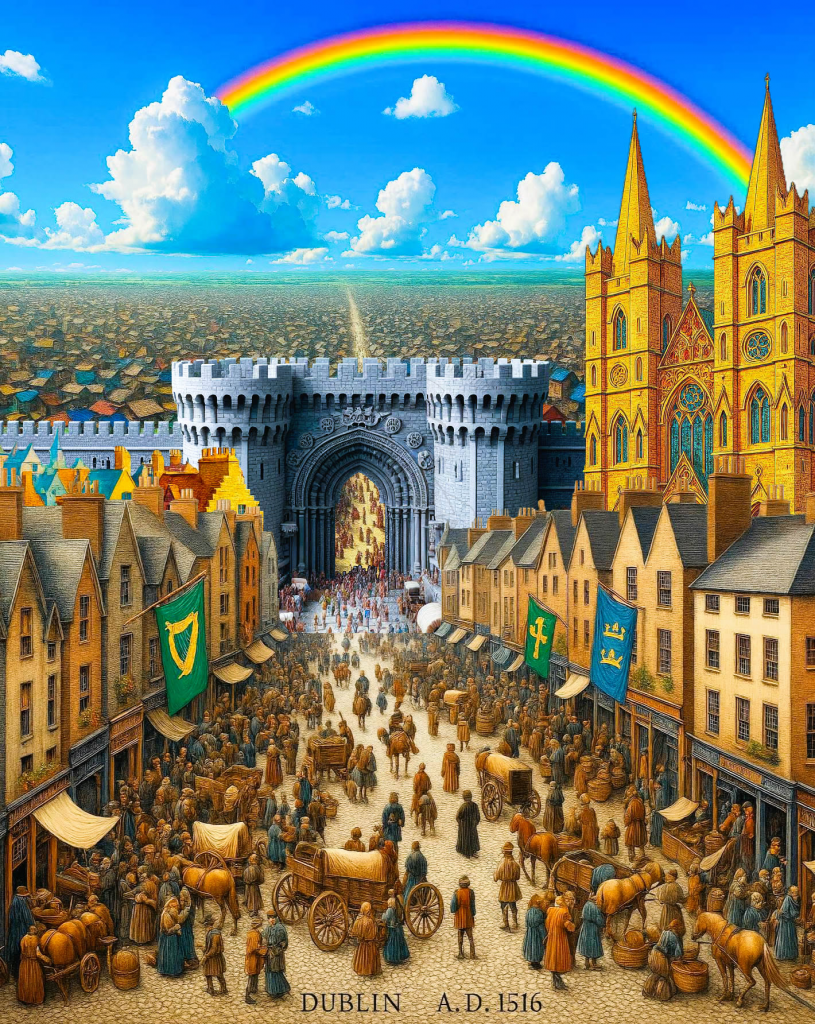
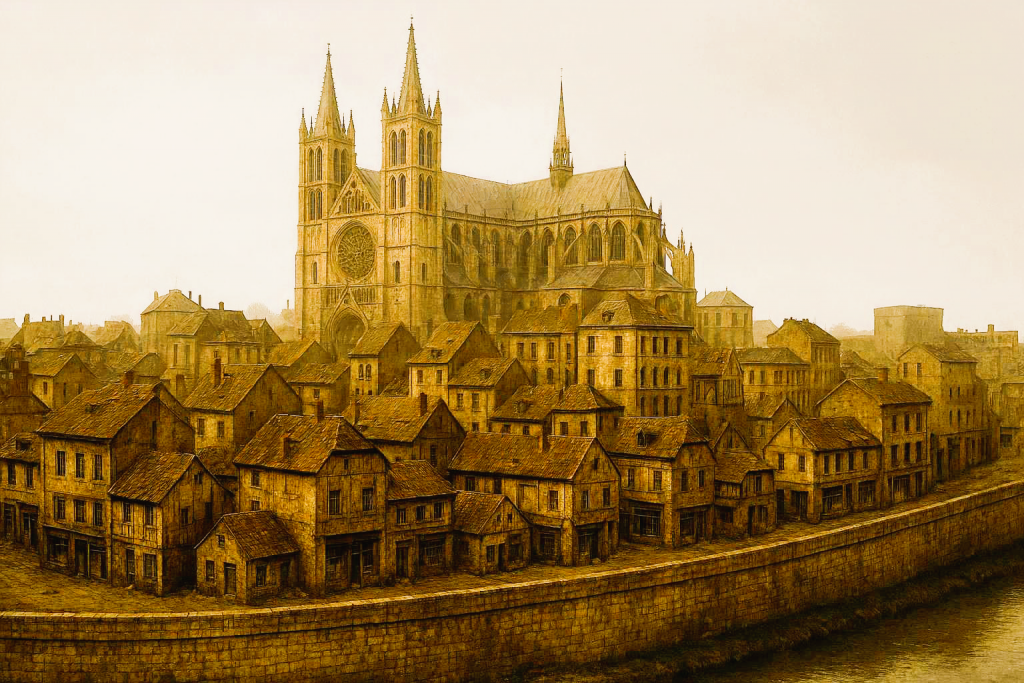
Friar Hugh laughed.  “That is St. Patrick’s Cathedral, the largest church in Ireland!”  A great stone church soared into the sky before them, comprised of two arched arms forming a cross, surrounded by an impossible number of homes, shops, and larger buildings clustered tightly around a network of narrow streets filled with people and wagons bustling about in every direction.  The vast majority of the buildings were wooden, with a very few stone structures scattered among them.  And looming behind them all, the massive stone walls of Dublin City stretched across the horizon.

“Is that where we’re going?” Char breathed in amazement.

“No, we’re going to the oldest cathedral in Ireland, Holy Trinity.  Often called Christ Church.  It’s our church.”

“Ireland’s?”

“Ireland’s, yes, but I meant, our Augustinian brethren’s, attached to our friary.”  And with obvious pride, he told them:  “Dublin is the only city in Ireland—maybe in Christendom, probably except Rome, of course, with two Cathedrals.”

“What makes a church into a Cathedral?”

“Trust your eyes, young master:  It’s as near to heaven as any place on earth.  Formally, it’s a church with a cathedra.  And before you ask, the cathedra is the throne from which a Bishop rules his principality.”

“Does that mean there are two Bishops of Dublin?”

“No, a single Archbishop of Dublin with a single palace at Holy Trinity.  But he has two cathedrals.”

“What does he need two cathedrals for?”

Friar Hugh’s face fell a bit, into a puzzled expression.  “I… don’t know.  Nothing, I suppose.  They used to have a big to-do about it but they held a synod to reach a truce between the two cathedrals.  So now they share the Archbishop.”  Then he shrugged, nodding with renewed reassurance:  “But the point is, Dublin has two cathedrals, and ours is the real one.”

“It must be truly amazing,” Char speculated, “To be chosen over this one—auckgh!  I smell animals and shit and—and—I don’t know wha—!”

This time, Friar Hugh, deciding he was being too liberal and knowing a potty mouth on the boy would not serve either of them well once they reached the Friary no matter how horrible the language he must be used to hearing, did cuff him this time, cutting off his sentence and chiding him:  “Time for you to remember you’re a church man, now!  The days of cursing and imitating the vulgar ways of farmers and animals are over!  The sooner you master that lesson, the better off you’ll be.   And for your information, that, unfortunately, is the smell of Dublin.  It’s not usually quite that bad, but you’ll get used to it.”

They were soon passing in the shadow of St. Patrick’s, and then that of the city walls as they entered through the massive St. Nicholas’s Gate.  On a normal day, had the Cathedral not already jaded them, Char surely would have exclaimed with excitement to see, and then pass through, the gate.  But he did proclaim his relief that they didn’t have to ford across this river, which Friar Hugh identified as the River Poddle.  And Char did not try to keep moving when Pen came to a dead stop inside the tunnel, looking straight up above him at the grate and the murder holes.  Instead, Char seemed fine with it, laughing at the sight of a boy lucky enough to be up in the fortress above them, perhaps the son of some officer, who was mimicking firing an arrow down on them.  Char gamely fired back while Pendragon marveled at the massive stone around them, until Friar Hugh took Char’s hand, the same way Char already had Pen’s, and tugged both boys forward.

“You two, stay very close to me from now on, do you hear?”  Hugh warned them, putting himself between the two boys so he could hold their hands.  “It’s obvious you’re newcomers to Dublin.”

“Yes, Friar Hugh,” Char answered for both of them.  “Why is that important?”

But there was no need for him to answer.  The next moment, the first of Dublin’s beggars and street sellers began assailing them.  Especially Char, who deduced it must be because his clothing was so much finer than that of his companions.  But also, he thought, feeling just a little bit pleased, it just might be because he looked the most beautiful.  That thought, in turn, darkened and troubled his mood, reminding him of the injustice his father had done to him today, how badly his back and bottom and thighs hurt (as if he needed more reminders of that), and most of all, of the massive and devastating consequence:  that he had been banished from his very home!  And while that suffering was his dominant reaction today, being recognized as beautiful (Char would not have said or thought that he looked like a girl, exactly—that was his beastly father’s insult), was always gratifying.  It always had been, as long as he could remember.  And now, although he wasn’t really aware of the fact, there was slowly emerging a in him a sense of defiance and even strength in who he was and his distinctness; especially that validation provided by the fact that he was beautiful and appealing to others, despite the awful untrue words of his father.

The rest of their walk was a blur to Char, so overwhelmed by new sights and smells and sounds and pitches from street people he could hardly keep up with them all.  Even if Char had been inclined to loiter and observe anything more, Friar Hugh wouldn’t have let him.  Fretting about the imminence of the ninth hour of the day, he urged them to walk faster despite the distance they had already come since morning.

When they finally arrived at the Friary, Char’s main feeling was one of relief:  relief that their long walk was over and he could rest his feet and legs; relief that Friar Hugh would not be taking Char any further away from the only home he had ever known (although he wished fervently, he was not as far away as he was); relief from the constant sensory overload of the unfamiliar city streets around them; and relief that the Friary seemed, well, nice.  Or at least, as nice as anyplace other than Shanganagh Castle could ever be.  Char was quite relieved Friar Hugh didn’t ask him what he thought about how the Cathedral compared with St. Patrick’s.  Char knew he ought to answer Christ Church was better; and he wanted to.  He was loyal!  But the truth was, he didn’t even know how to compare them to each other.  They were the two largest churches he had ever seen, and while he could tell the architecture, outer buildings and even, to some extent, the layout of the buildings were different, they were really, compared to everything else he had seen in his young life, similarly remarkable.  They were more like one another, and distinct from everything else.  Probably, he would come to appreciate how Christ Church was better than St. Patrick’s as he learned more about his new home.

Char was astonished when Friar Hugh led them around the cathedral and back into yet another one of the teeming streets of Dublin to reveal yet another church, right across the street from Christ Church!  Compared to the two cathedrals, he supposed this latest church could be considered a regular church, even a small church; but it was easily the size of Shanganagh castle itself.  And Char was pretty sure he had seen more churches to his left and right in the short time it took them to get from St. Patrick’s to Christ Church.  Char thought there were more people on each block and lane they saw, than he had encountered in his entire life living at Shanganagh Castle; but even so, he couldn’t imagine what they needed so many churches for.  Not when Christ Church and St. Patrick’s were so huge!  He was sure the entire English population of Ireland would be fit into either one of them without feeling crowded.  Finally, beside the second church, across the street from Christ Church,  they reached a cluster of suitably sober wooden and stone buildings a couple of blocks Northeast of Christ Church Cathedral itself.  Friar Hugh led them onto the Friary grounds, finally letting go of their hands as they entered another small church (which Friar Hugh explained was a private one for the friars), then turned through a door in the side of the nave that led to the back of the refectory, where a man Char would soon learn was the Archbishop of Dublin himself, was calling the brothers to none, the ninth-hour prayers.  Catching sight of them, he frowned curiously at Friar Hugh, who Char thought reacted almost as if he were nervous, before returning his focus to the office.  This one was much longer than sext had been, or indeed any service Char had ever been to except the mass, consisting of an Invitatory hymn, hymn of the hour, twelve psalms, the capitulum, a versicle, the Kyrie, the Lord’s Prayer, the oratio, and finally concluding prayers.

Again, Pendragon made the appropriate physical motions, matching those of everyone around him; but did not sing, chant, or pray, and neither seemed to pay attention to, or disregard, the Archbishop when he spoke.  Char couldn’t believe how long the office continued.  Even back at the castle, it was all he could do not to fidget and get in trouble.  Now that he had joined—or, more properly, been joined to—the religious life, he was about to encounter a daily divine office, six times a day and once in the middle of the night, he had never even imagined before.

After it was over, Friar Hugh waited nervously, greeting those of his senior brothers who made eye contact with him as they left the refectory, most of them heading to the cloister or the calefactory beyond, now that the workday was done. Their curious glances, and the intimidating glare of the archbishop, made it clear how unusual their presence here was.  It also struck Char what a contrast the two of them made, Char clean and fine in his embroidered dress and expensive shoes, while Pendragon was rough and barefoot in his simple dirty and blood-spattered robe. 

With a sharp sigh of resignation, Friar Hugh motioned them forward and Char took Pen’s hand to pull him after them:  “Come on, stupid.”  The archbishop had signaled two other, older brothers to wait with him, whose robes marked them as holding rank within the Augustinian Order; but having never been to a religious community of any kind before, Char could not identify their offices from their appearance as readily as he could identify the Archbishop.

Friar Hugh bowed his knee to the archbishop, imitated closely by Char, greeting him as “Good evening, Lord Dublin.  Provincial Clement.  Prior Stephen.”

“Good evening, son,” the archbishop responded on behalf of all three men, his frown sharpening at Pendragon, who seemed to notice his companions kneeling but was slow to imitate them, something like confusion touching his otherwise still-daft features.  “Now who are these children, why have you brought them here, and what is wrong with that one?”

“This is young Master Charles, My Lord, the son of Lord Wrathdown.”

“‘Pon my Faith,” the Archbishop interjected without even thinking, at the mention of one of the Friary’s biggest sponsors, shaking his head.  “Another one?”

“I apologize, My Lord,” Friar Hugh clarified.  “I was unclear.  This is his youngest child by his marriage to the late Lady Wrathdown.”

“A legitimate son?  That’s going to be a different problem altogether, isn’t it?”  the archbishop looked askance at his colleagues, who nodded ruefully.

Char didn’t understand what they were talking about, or what could possibly be unclear about describing him as his father’s son.

Looking back at Friar Hugh the archbishop demanded:  “And you agreed?!  And to this… who or what is this?” he gestured towards Pendragon.

“Lord Wrathdown is… I’m afraid, most persuasive, my Lord.”

“Horrifying, you mean!”

“But perhaps we should discuss this privately?” Friar Hugh suggested, looking askance towards Char.

“Can Prior Stephen deal with this?”

Friar Hugh looked pained.  “Ah… Lord Wrathdown suggested they might join the cathedral chorus…?”

“God’s fury!  Choirmaster Adam—”  And with a glance toward Char—whether from concern for a child’s welfare, or concern about what said child might reveal to Lord Wrathdown, was unclear, “Yes.  Of course.  Come along to my office.”

The boys followed the men out from the rear door of the refectory into the cloister, where several monks wearing heavy leather gloves were paired against one another, hitting inflated bladders back and forth between them, sometimes even bouncing them off the walls, while other friars watched or spoke with one another.  Char, and even Pendragon stared in amazement at the spectacle, both of them stumbling over the same crack in the cloister walkway as they stared backwards instead of watching where they were going.

After a quick walk down one side of the small cloister, they stood in a corner with an open door to a library on their left, and an open door to a short entryway in front of them, with the calefactory on the other side of it and a steep stone stairway to the left of it.  The archbishop led his friars up the stairs and out of sight while Friar Hugh herded the boys against the wall of the cloister into the small corner between the two doors.  “You two, wait right here and watch the game,” he instructed them, nodding for emphasis, before turning and hurrying after the archbishop. 

Char, his ears burning to know what they were saying about him and his family and why they didn’t want him to hear, immediately looked at Pendragon and urged him:  “Come on, let’s go!”  He began walking and pulling Pendragon’s hand, but when the red-headed boy followed him too slowly, he hissed:  “We can’t wait!  Keep up!” over his shoulder.  Frustrated with Pendragon’s lack of speed, he let go of Pendragon’s hand, and hurried up the stairs before any of the monks sitting in groups chatting animatedly around the fireplace in the middle of the calefactory, took any notice of him. 

The stairs wound tightly in a “U” shape, to a hallway above the calefactory leading to a muniment room (a vault for protection of the brothers’ vital papers), other small dark rooms, and the Archbishop’s office, or episcopacy.  Char was just in time to see the episcopacy door closing behind Brother Hugh.  Motioning Pendragon to follow, Char scurried quietly to the door and pressed his ear against it. 

It was only then, turning his head back the way he had come so he could push his ear flat against the door to listen, that he realized Pendragon was nowhere to be seen.  Pressing his lips together to prevent himself from cursing aloud, he felt torn about whether he should go find him.  But the chance of the boy going anywhere without Char pulling him seemed small, and he was simply too curious to abandon his post.

The archbishop was speaking:  “He’s never shown any interest in song or—” the archbishop snorted as the other men in the room laughed.  “Any aspect of Christianity or civilization, for that matter, before.  Except weaponry.  Is it his new wife?  Does she have an interest in the church?”

“No… Lord Wrathdown is concerned the ladies of the castle are exercising an undue influence on him, and wants us to make a man of him.”

“Then why doesn’t he squire him out like his brothers to one of the other marcher lords?”

“The lad does have more of a… religious disposition,” Friar Hugh explained.  “Patient and social.”

“He didn’t even know what to do with the boy, did he?”

“But, unfortunately, ah—not a serious intellectual.”  Charles felt himself blush red with a combination of humiliation, hurt, and anger, knowing it was true but still affronted to hear others saying it.  It made it worse he couldn’t completely make sense of what they were saying.  But he understood this.

“Ah,” the Archbishop pronounced, as if finding something wrong with a discounted apple.  “Of course not.  And the bastard—a simpleton?”

“I actually don’t think he’s Lord Wrathdown’s.  According to this letter from Brother Matthew, the parish priest for Keen Bray, he’s Pendragon Argent.  His father was Lord of the Manor in Raheen-a-Cluig.  The whole family, and practically the whole manor, were slaughtered or enslaved by the O’Brians and the O’Tooles.”

The other men made sounds of sympathy and condemnation. 

“He claims the lad is quite bright and intelligent, although he hasn’t spoken a word since seeing his family butchered.  Lord Wrathdown wanted him to accompany his child into the church as a tutor to help him with his studies.”

“It seems that would be useful,” the Archbishop conceded, “If he’s actually diligent, and if he recovers from his stupor.  Otherwise he’s just more dead weight.  But in any event, he’s still another lamb from Wrathdown for us to tend.  Are they particularly good singers?”  he asked hopefully.

“I don’t know, My Lord.  Lord Wrathdown didn’t say.”

“Didn’t imagine that was important for our chorus, did he?  I mean,” laughing again, “He’s never shown any interest in song.”

“Or prayer,” Provincial Clement noted.

“Or, really, any part of the service,” Prior Stephen concluded as the three of them chortled.

“Brother Matthew’s letter pleads in the strongest possible terms for Lord Wrathdown to place the orphan in a school, the best to be found,” Friar Hugh explained.  He didn’t need to add “which is us”—it would seem almost like a betrayal of the Augustine order to suggest otherwise.  “He was more interested in his own boy’s education and vocation than singing, I think, My Lord,” Friar Hugh suggested.

“He wants that Manor for one of his older legitimate children, you mean,” the Archbishop retorted.  “The daft lad is never going to be a knight no matter what his disposition.  But if they can’t sing—you know how particular Friar Adam is about his angel choir!  Every one of them must have the perfect voice and the perfect look.  He’s threatened to quit before!  I’ll never hear the end of it if I force him to start taking on bright-haired choristers just because they want to go to school!”

“Perhaps they could attend his grammar classes, but not the choral ones or sing in the choir?”  the Provincial proposed.

“But they’re obviously still children!  What do you think—at least another year or two until they’re ready for grammar school?  The Augustinians don’t operate dame schools!”

“Or any facilities for the care of children, except—”

“The bastard house.”  There was a shuffle of uneasy laughter.

“I’d prefer we refer to it by its proper name, please:  The Augustinian Charity House of Our Ladies of Lesser Mercy Mary Magdalene and Salomé,” the Archbishop clarified, his tone managing to change from warning to thoughtfulness in the course of a single sentence.

“But… surely not for the Lord’s legal child?” Prior Stephen sounded worried.

“It’s been good enough for his bastards.  Not a word of complaint in almost a decade now.  Not from any of them.”

“Not a word of any interest at all,” the Prior conceded, “but for a child carrying his own name….”

“There doesn’t seem to be great warmth between them,” Friar Hugh conceded.

“Then why not just send them to Sister Phillipa?”

“That wolf’s den?”  Provincial Clement asked skeptically.  “I mean… Phillipa’s were one thing, and that made it logical to send the others, but…  They’ll eat these two alive, won’t they?”

“It’s the only orphanage in Dublin!”

“But what other choice do we have?”

Sounding thoughtful, the Archbishop mused:  “What if we put them in the Charity House, but we could find them a more-suitable guardian?”

“What lady of character would agree to live there?

“She’d be living at the orphanage, not the… grange buildings.  It’s a perfectly respectable street.  What about the boy’s governess?  Could the Baron be persuaded of the importance, for continuity and his acculturation…?”

“I’m not sure,” Friar Hugh prevaricated.  “The Baron seemed… personally fond of her…”

The Archbishop, the Provincial, and the Prior all groaned loudly and incredulously.

“And she’s the boy’s step-aunt.  But the Baron ordered all of his new wife’s family to leave Wrathdown as soon as his next child is born because he doesn’t want any weak female influences on his next son.  So…”

“That’s ridiculous!  Who else is going to raise children this young?!  I’m going to consider how we might persuade her to join us at the Charity House, preferably without Lord Wrathdown learning about it quite yet….”

Another one!”  Char was confused for a moment trying to identify the voice, that of someone new, so intent on hearing the faint speech through the door he was ignoring the hallway altogether, before he caught movement from the corner of his eye and scrambled to something like a position of attention at the sight of an elderly man with a slightly hunched back moving with difficulty, but determination, dragging Pendragon behind him. 

Char, caught and momentarily panicked, looked around as if there might be somewhere for him to run; or indeed, as if he had any reason to run.  But having been found, any reaction was already too late.  The old man was throwing open the door of the episcopate and hauling both boys inside by their arms. 

“These must be the little scoundrels Brother Hugh brought us!”  he roared, as the men in the room turned and looked at them in surprise. 

The Archbishop’s office was unremarkable except for its relative warmth, a product of its location above the calefactory:  The space itself was quite small, and although his personal effects were well-appointed, appropriate to his position as a member of the nobility, they were not excessive.  It was more a case of the reasonable things anyone would keep in their office, being of the finest quality; than an ostentatious display of wealth showcasing unnecessary possessions.  It was entirely in line with Char’s own experience and expectations; if anything, it was the simplicity and basic functionality of the Friary’s other furnishings that stood out to Char.  It would have been too strong to say this room was the first place he felt at home, even with a rough manor like that of Castle Shanganagh for home; but it was familiar to him.  There were only two chairs besides the Archbishop’s own, occupied by the Provincial and Prior, with Friar Hugh standing attentively to one side of his three superiors.

“I found this one listening outside the door, My Lord!” the old man growled as Char turned scarlet with embarrassment.  “And this one tearing up the books in the library!”

“I would never damage a book!” Pendragon exclaimed, surprising them all not only by speaking, but with his vehemence in defense of books, which turned immediately to a gushing tone of praise:  “You have so many, I just had to investigate!  Father Matthew told me about the libraries in Dublin but you have three whole rooms of books!  And the moment I saw your Pentateuch I knew at once it was an illuminated manuscript!”

The room froze for a moment.  The four churchmen determining the boys’ fate looked nonplussed as they tried to catch up with the rapid sequence of interruption, charge, and information bombarding them.  Char, who hadn’t really believed Pendragon could talk at all, stared at him in shock for that fact alone, without registering anything about the content of his speech.  But the old man seemed to be the most surprised of all, well and truly flabbergasted at the words coming out of the boy’s mouth.

“What?”  He asked, automatically, without even thinking about it.

“They’re even more beautiful than Father Matthew said!  I want to make illuminated manuscripts.”

The churchmen looked at one another suspiciously for a moment, as if trying to sort out how they were being tricked.

You can’t read!” the old man charged impulsively.

“He’s of gentle birth, Brother Griffin,” Friar Hugh explained.  “Despite his appearance.  He’s just barely survived an Irish raid that destroyed—well, a bad Irish raid,” he amended hastily, not wanting to re-traumatize the boy.  “Can you read Latin?” he asked the boy, feeling compelled to prompt him as if, by being forced to bring him to Dublin, he had become the boys’ involuntary sponsor and patron.

“Latin and English well, Father.  A little bit of French and Irish too.”

“Iri—!” several voices began at once.

But fortunately for him, he immediately diverted their attention by concluding:  “But I want to learn Greek, most of all!”

“You what?!” The Archbishop asked incredulously.

“Greek?”  Char blurted out, confused and still off-balance from being caught.  “What’s that?”  And then, without meaning to or understanding he had done so, he asked what everyone in the room was thinking, but none of the clergymen wanted to ask because questioning the desire to learn was so at odds with their educational mission and role:  “Why?

“Father Matthew says that by reading works in Greek, Erasmus—”

Erasmus!” several voices cried in surprise.

“—is discovering an entire lost world of knowledge and faith!  More important than the Spanish Conquistadors in the New World.”

Pendragon stopped, realizing everyone was staring at him slack-jawed and misinterpreting the silence.  Nervously, he added:  “I’m sorry for speaking out of turn, Masters.”

A cunning smile slowly spread across the Archbishop’s face, beginning in his eyes before reaching his mouth.  His Augustinian brothers, familiar with this look, suddenly glanced at one another nervously.  “You’re sincere in this, aren’t you, child?”

“Oh, yes My Lord!”

“I only know of one speaker of ancient Greek in all of Ireland,” the Archbishop spoke slowly, looking at Father Griffin.  “And he’s most eager for students.”  It would have been more accurate to say, he was vociferous in his praise for the ancient Greeks, their philosophy, and their language; and seemed unable to contain himself from urging his brothers to take up the language and suggesting the ability to read Greek was a virtue in the church.

“I would be honored to meet him, My Lord.”

“You already have.  He’s standing right in this room.”  Pendragon looked astonished.

Father Griffin’s face, cycling rapidly between expressions, betrayed the fact he might have objected in other circumstances; but he was clever enough to recognize when he had managed to entrap himself, and sensible enough not to argue from a position of weakness with the Archbishop once he’d made up his mind.  He grasped at the only means of escape available to him:

“But—My Lord, they’re children!  Not even ready for grammar school.  Not yet of an age where they can even comprehend reason.”

“Brother Griffin is right, of course.  You both are too young.  As they have both demonstrated tonight by ignoring Friar Hugh’s instructions.  But as I reflect upon our conundrum, your father” he addressed Char “and your mesne lord, now that you’re the head of your family,” he looked meaningfully at Pendragon, “Has made it clear his will is to place you in our care, whether any of us think you’re ready for it or not.  So, you have exactly two choices,” the clever Archbishop, an expert manipulator of people, concluded.  “You” (looking at Pendragon) “can, against all odds, have your heart’s desire, to learn Greek, as you claim you wish—if that is what you truly desire, if you only help your young master here to behave himself and learn well enough to remain with us.  And you” (looking at Char) “Can learn what Greek is, and at least do your best to act like you’re suited to being a man of the church, while you try to become one with the help of your young friend.”  Turning to Father Griffin, he continued:  “You can show your brothers the value and inspirational meaning of Greek, andI can let Brother Hugh report back to Lord Wrathdown that his wisdom is indisputable and his donations to the Augustinians are as useful to him in this world, as they will be in the next.”

“Or.”  He paused, looking around at all of them to ensure they understood the gravity of the next part, landing on Charles first.  “We can send you back to your father, telling him you’re too undisciplined for the church, ignoring your superiors and listening at doorways!”  Char shrank back, swallowing and shaking his head at the suggestion, even before he finished the thought:  “You’ll have to squire for him and your older brothers if no one else will have you.”  Prior Stephen looked pained at the degree of stress the archbishop was putting on the poor boy.  The Augustinians all knew returning him to his father would be an extreme last resort because it would incur his displeasure.  But Char didn’t; or at least, he was much more sensitive to the ire that would be directed at him, than at these churchmen.  Turning to Pen, the archbishop continued:  “And we can send you back to Brother Matthew, telling him he overestimated your interest and aptitude.”  Finally turning to Brother Griffin:  “And you can give up on this rare opportunity to share your gifts with someone who is genuinely interested in them.”

“I understand, my Lord,” Brother Griffin answered, seeming more chastened than upset.  “Your wisdom is indisputable.  But truly, I’m afraid I know little about teaching and caring for children.”

“None of us” and here he may have been referring to the religious brothers of St. Augustine in Dublin, or more broadly to the entire male gender, “do.  Or even about the teaching and care of young men, except Brother Adam.  These two will have to live for now with the other children in our care, at Our Ladies’, until they are old enough, and their voices ready enough, that we can induce Brother Adam to accept them.  See if a singing teacher can be arranged for them and let Sister Phillipa know they should have a separate room from the others.  With a window, in case Lord Wrathdown should inquire.  And attention and care appropriate to a noble child.  In the meantime, the boys will attend the Dame School in the morning and study Greek with you, Brother Griffin, in the afternoon.  When they can convince you of their ability to study and behave, they will commence studying Latin, French, and English with the other choir boys in the morning; and when they can convince Brother Adam they’re ready, they can try out for his choir.

“In the meantime, they will observe the full holy offices when they are in our care, just as the choir boys do; but when they are with our lay brethren, they may continue the more relaxed observances at Our Ladies’.  Since the chorus, the library, and the orphanage are all properly affiliated with Holy Trinity Friary, I’m certain Father Stephen can coordinate the details of their care and schedule as he sees fit without being troubled by Provincial Clement or me.” 

Provincial Clement looked as pleased with the arrangement as Archbishop Dublin was with himself for solving several problems at once whilst extricating himself from all of them, spoiled only when he saw the look of confusion and worry on Pendragon’s face.  “What?” he asked, not quite with the solicitous tone of voice a young man under the Cardinal’s care might want to hear.  But the prelate couldn’t have imagined what was coming next.

“My Lord, it’s just—” Pendragon swallowed nervously, looking around the room, looking embarrassed, before whispering:  “Holy Trinity Friary is in Dublin!”

“Aye?”

“How did I get to Dublin?!

Literature Section “08-02 Between Heaven and Dublin, England”—more material available at TheRemainderman.com—Part 2 of Chapter Eight, “The Wild, Wild West”—6657 words—Accompanying Images:  3839-3842—Published 2025-12-27—©2025 The Remainderman.  This is a work of fiction, not a book of suggestions.  It’s filled with fantasies, stupid choices, evil, harm, danger, death, mythical creatures, idiots, and criminals. Don’t try, believe, or imitate them or any of it.
CAUTION:  Contains themes of war oppression child and domestic abuse and bigotry some readers may find disturbing.

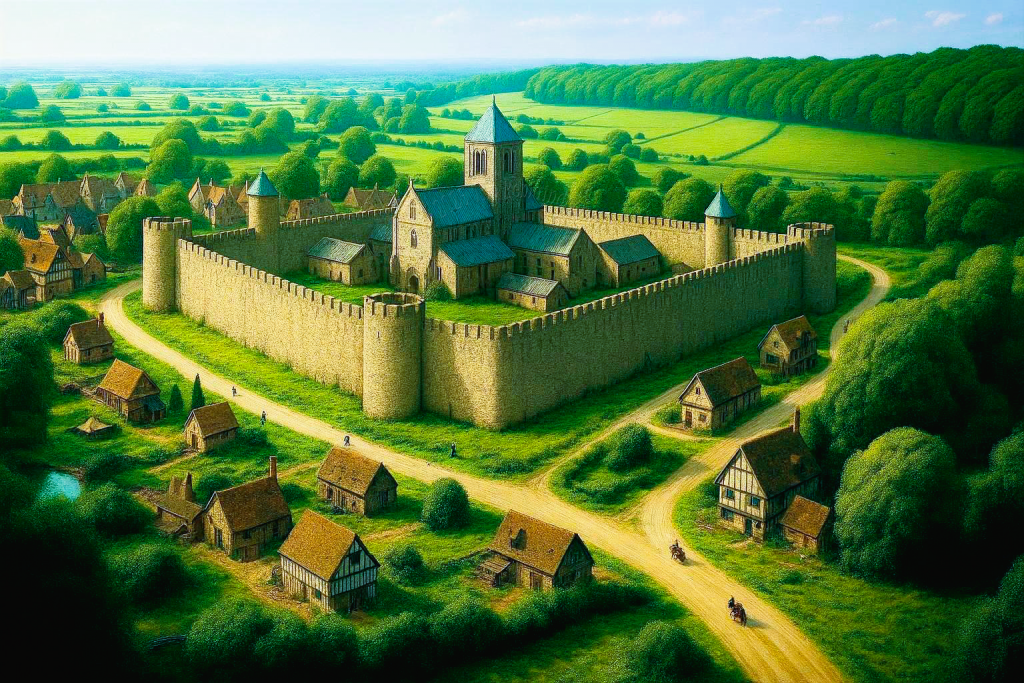
Explicit version of image 3483 08-01 We killed 8 Irish savages! containing graphic horror themes at 08-01 Identicide in Ireland:  Annihilating Childhood at Patreon.com/TheRemainderman

“I miss him,” Edith admitted wistfully.  “And worry about him.”  She had moved to an arrowslit on the South wall, which served as one of the chapel’s windows, and was peering down at the Bray Road below trying to see the horsemen they had all heard clattering past.  The arrow slits, being cruciform, were in a way quite appropriate for the chapel, which was being used as a makeshift classroom for the petty school students aged 4-7.

Edith and her friend Char, the youngest child of Baron Wrathdown, were embroidering their Lord’s banner together, working on a magnificent bolt of blue silk from China.  Char was using fine golden thread to embroider a castle, one of nine on Wrathdown’s coat of arms, while Edith was using fine silver thread to embroider the raised sword beneath the three castles in the center column.  As they did so, their mothers were gossiping and brushing their long hair.  The other ladies of the half-sergeanty sat around them with their daughters, working on projects while the children’s tutor, Father Hugh, an Augustinian friar, wrang his hands and tried to decide how quickly he could excuse himself to chase down the rest of his students—the women’s sons, the girls’ brothers—who had bolted excitedly from their lessons to see what all the racket was about.  The clergyman couldn’t quite mind their absence for a bit; they bleated and fidgeted like excited goats.  Girls might not have the intellect for learning, but they certainly had the superior manner.

“I want my father to come back,” Edith frowned.

Char responded matter-of-factly, “I don’t,” provoking a dutiful tutting sound of disapproval from Lord Wrathdown’s sister-in-law, Lady Kynborow, and a satisfied smirk from his mother-in-law, Lady Parnell.

“Your fathers’ work is important!” Father Hugh reminded both of them, presumably intending to comfort or reconcile them in some way.  “All Ireland is divided into three parts:  Gaelic, Norman, and English.  The wild Irish savages have overrun most of the North and West, and unfortunately, the wilderness just to the South of us.  Most of the ancient Norman lords, themselves bastardized by their time in this godforsaken land—”

“Sir!” Lady Kynborow laughed, scandalized, pausing in her hair-brushing to put her hands over Char’s ears.  Her ladies laughed with her; and their daughters, according to their age and disposition, either smiled uncertainly or looked nervous.  “We are the source of civilization here.  We must set an example!”

“Quite right, Lady Wrathdown!” Father Hugh agreed, as if Lady Kynborow had been confirming his point rather than criticizing his language. “The Norman Earls beyond the Pale—they’ve become more Irish than the Irish, lacking all appropriate devotion to Ireland’s proper Lord, our blessed King Henry, designated to rule here by the Pope himself!  They aren’t reivan’ and raidin’ us like the Irish sinners, but they aren’t loyal, either!  Only we, the good Kings’ men of the Pale, the land behind the wall, the Lordship of Ireland, are the lone outpost of true English culture here!  Your fathers’ work defending the Church and law and order is the work of King and Christ, children!”

“Yes, sir,” the children dutifully responded, exchanging meaningful looks expressing their fervent hope his speech would not inspire another lengthy prayer begging God to strengthen their fathers’ hands against the murderous clans to the South.

But Father Hugh was going in another direction, shaking his head, lost in thought:  “Beyond the Pale it’s all chaos and cannibals—”

Edith gasped excitedly.  “Cannibals!”

Thank you, sir,” Lady Kynborow gave their priest a significant look.  “I think that’s enough on that topic.”

Father Hugh tried without success to look convincingly distressed.   “Yes of course, Lady Kynborow.  I just meant, they’re barbaric!  They don’t even wear shoes!”

The girls giggled, while Lady Kynborow’s mother, Lady Parnell, muttered:  “No need to mind your language on our account, Father.  There’s not a child in Shanganagh Castle left with tender ears,” provoking more giggling from the older girls.  Wrathdown was shaped and practically defined by its role defending Dublin against perennial Irish raids from the Wicklow Mountain country.  It had a rough-and-ready martial character that preceded, but certainly could not eclipse, its present Lord, who practically personified the Norman warrior ethos of old.  The force of his personality had imprinted itself on every male in the castle and the countryside alike, and even attracted a number of rugged young adventurers from England and elsewhere to try their hand against the Irish.  It helped that there were more manors than knights here on the border, available to anyone with the wit and strength to secure a hold for themselves in the name of the Pope and the King.  Even in a man’s world, the Irish frontier was man’s country in 1517, with women living on the margins of daily life.

“Mother!”  Lady Kynborow repressed a smile.

“Don’t pretend otherwise.  Char’s muckspout father—”

As if to make her point, at that very moment Baron Roland, Lord of the Half-Serjeanty of Wrathdown himself, threw the door open hard enough for its hinges to rattle and the latch to chip off a bit of stone from the wall of the small castle.   Very much a Marcher Lord, wielding a real and direct military power to prosecute his King’s war that most English barons lacked, the Baron maintained nine front-line castles shielding Dublin from the depredations of the Irish natives to the South, all connected by earthen barrier walls running from the Irish Sea at Wrathdown Castle to the border with Uppercross past Templeogue Castle.  They imposed a significant burden on the modest revenues of the Sergeanty, even with the subsidies he received from the viceroy’s Dublin Castle administration. 

So it was hardly surprising the castles were compact, efficient, and coarse, combining the functions of defense with those of daily life.  The chapel, occupying the third floor of the small castle, was used for everything from mass to feasts to rare tax-exempt markets and classes like this one, especially in warmer months when the welcome light and fresh air provided by the third-story arrowslits compared most favorably with their drawbacks in winter, a time when they were usually filled with loose bricks.

The excited boys of the castle swarmed back into the room, swirling around the Baron and his companions like a Huntsman’s dogs howling and barking in excitement while dodging the hooves of angry stallions.

“God’s light!  Finally!  Here you all are.  I practically ransacked the castle.  What divine office are we celebrating mid-afternoon?!  We thought the damned savages must have taken the lot of you!” 

Lady Parnell directed a look at her daughter as if the obvious had been revealed, but otherwise there was little enough room for anyone else when Lord Wrathdown took the stage.  Stinking of smoke, sweat, and offal, his clothing and skin were stained and spattered reddish-brown with dried blood, the clean patches of his head and chest revealing where he had removed his helmet and cuirass upon entering the castle. 

“Papa!”  Edith cried as her father, Sir Ambrose, entered behind his Lord, thwarted in her attempt to hurry to him by her mother, who hugged her tightly.  Sir Ambrose was half-leading, half-pulling an auburn-haired, dazed-looking barefoot boy of about 5 or 6—Char’s age—in a gown behind him.  Both of them were bloodstained and filthy, if less so than the Baron himself; and the boy’s air of detachment and lack of focus were only reinforced by the contrast he made with the intensely involved and overstimulated castle children.   Edith’s father smiled encouragingly at her, but with a gently raised palm, urged her to wait.  No adult in the room imagined it a good idea to compete with their Baron for attention.  And in fairness, the man was larger than life, well over six feet tall with broad shoulders, strong arms, and an impressively-long beard demonstrating his virility.  His personality was as loud and brash as his speech.  Edith’s father could not have competed with that if he’d been of a mind to; and he was far too sensible to have any such thing in mind. Of his six half-brothers, children of his father’s first wife, only three had survived childhood.  One, it was rumored, had gotten in the way of his ambition and died gruesomely.  A second, eager to stay out of his way, had joined the church.  The third, and eldest, was an Earl of the family’s main estates in England, and doubtless hoped Roland’s inheritance in the Pale would keep him busy.

The last member of their party to enter, marked in the same stains and smells as the other three, was Young Roland, the Baron’s firstborn son, unmistakably of a kind with the Duke himself, Lady Kynborow, Char, and even the silver-touched Lady Parnell:  Every member of the family’s hair, on both sides, shone a blazing yellow-gold.  Theirs was the hair of lions, not just yellowish, but a strong, saturated hue that made other shades of yellow look washed-out or dirty.

“Yesterday was a magnificent day!  We caught half the damned O’Tooles, and the O’Byrnes too!  Out looting and burning in Bray and Shankhill.  I collected six Irish heads!” he roared proudly, gesturing impatiently at his son.  “Show ‘em, lad!” 

Char and the ladies cried out and recoiled in horror as Young Roland, grinning proudly, held up two strings of four heads each, with their hair braided and bound together with rope like obscene cloves of garlic.  “I got two of my own, Aunt Kynborow!” he boasted enthusiastically, smiling so proudly she felt obliged to smile back at him with the same enthusiasm a peasant woman would greet a housecat returning with a dead mouse in its jaws.

“That’s nice, dear!” she applauded, doing her best and elbowing Char, who, jaw set and arms crossed, ignored her.  “Isn’t that nice?”  And when ignored by Char, pressed her husband, who had married her in swift order after her sister, his first wife, had died:  “God bless you on your victory, my Lord!”

He rumbled angrily.  “More of a draw.  But it was a glorious, unholy bloodbath!  The manor of Raheen-a-Cluig’s a goner.  The men of the village were strung up and cut up into ribbons, and the women and children who weren’t raped and butchered were taken by the O’Byrnes.”  Neither Lady Kynborow nor anyone else in the room thought about chiding the Baron for his language. “Lost for good up in the mountains.  But it wasn’t all bad, we left the dirt soaked with their tainted Irish blood, and caught a few slaves for the lead mines.  Oh!  And here, give me the lad!”  Roland gestured to Ambrose, who gently nudged the dazed boy toward his Lord, who seized his arm and hustled him forward.  “My knight and his wife were dismembered with the rest of the manor in most grisly fashion, must have screamed for hours!  But this one hid.  Or, more like, the Irish just didn’t want anything to do with this odd fellow.” Roland shook him slightly for emphasis to make sure Parnell and Kynborow understood who he was referring to.  “Their son and heir.  He’s my ward now, and in addition to bringing me his rents, the parish priest in Bray says he’s a sage in the making.  That note’s for you, Father,” Roland jabbed his finger toward a reddened scrap of paper pinned to the collar of the boy’s robe.  “He’ll be a perfect tutoring companion for that worthless son of mine, who wasn’t with the rest of my wild dogs—” he gestured vaguely towards the boys tripping over themselves to follow him around.  “Where is that prat Charlie?”

Something in Kynborow’s guilty expression must have alerted the Baron to the truth because his eyes widened and bulged out, his face turned a mottled purple, and he bellowed:  “My son?!  You’ve got my son there brushing his hair?”

Young Roland guffawed nastily, and even the unfortunate orphan blinked twice, the closest thing to an expression of any kind, facial or verbal, he seemed able to muster, as Lord Wrathdown dumped him unceremoniously onto an empty pew and barked “Shut up!” to his eldest.  Nobody else in the room required such a caution; not one of them, not even the stupidest of the castle boys, dared meet the Baron’s eyes, let alone make any sound that might catch his attention.  “He’s SEWING?!?!  MY SON is SEWING with his Aunt instead of playing with his friends?!

Edith is my friend!”  Char murmured, ducking his head and shrinking back into Kynborow even as he spoke.  “not them!

“Please, my Lord!”  Lady Kynborow—having no way to avoid the Baron’s attention—pleaded.  “He’s only lost his mother last winter—let him have some peace!”

SEWING AND PLAYING WITH GIRLS?!  The Baron Wrathdown’s SON?!  I think not!”  Baron Roland roared.  “Clearly he’s better off with her dead!  But YOU—” he jabbed his finger into Kynborow’s shoulder “won’t be following in her footsteps!  I never should have listened to a word from her!”

“ROLAND!”  Lady Parnell snapped.  “We’re your family!” biting her lip and retreating sharply as Roland turned on her.

His attention was distracted back to his son as Char burst out crying:  “I wish it was you dead!”

What’s wrong with you?!  BESIDES the coddling of these women?!  That’s it!  I’ve got to do something to save you, and our family honor, from your weakness!”  Roland growled again, wading forward to tear the child forcibly away from his aunt, throwing him down over a pew and thrashing him with the flat of his blade—cleaner than his own flask, and doubtless the only thing beside his horse and other weapons Lord Roland had made sure were tended after the battle—while Lady Parnell held Lady Kynborow back, every woman in the chapel started shrieking, and even Father Hugh murmured nearly-audible protests, waving his hands ineffectively as he considered whether and how he dare intervene.  Continuing to wallop on poor Charlie’s bottom, the Baron continued his diatribe:  “We’ve got to get you away from these damned women!  You’ve clearly been coddled and indulged by women long enough!”

“No, please!”  Lady Kynborow wept, as the Baron’s arm rose and fell, rose and fell, over and over again, on his suffering child.  “Please, Roland!  That’s enough!”

“No son of Roland Wrathdown sews and brushes his hair like a woman!”  It almost sounded like Lord Wrathdown was weeping with his frustration and rage, his eyes filled with the same reddish-purple fury that stained his face and every inch of visible skin.  “No son of Roland Wrathdown plays with girls instead of boys!  I thank the lord he gave me six good and manly boys before this one was sent from hell to disgrace us!”

Lady Parnell and several other women were trying to restrain the hysterical Lady Kynborow who was screaming and crying and trying desperately to protect her nephew, while Sir Ambrose and Father Hugh edged nearer to the Baron with their hands raised placatingly, ineffectively trying to encourage the Baron to stop.  Behind them, the red-haired boy sat still and slumped where the Baron had dumped him, staring listlessly toward the altar with his unfocused, haunted sapphire eyes, showing no interest in—or even awareness of—the maelstrom around him.

“If I thought he was man enough, I’d squire him to Lord Nethercross, he’s a hard man!  But I won’t let this prating grovelsimp embarrass the family!  None of my other boys have gone for the church.  We can send him!

“We would be honored,” Father Hugh assured him eagerly.  “In a year or two, when he’s ready—”

Not a year or two.  NOW!  Before he’s irreversibly contaminated!”  Lord Wrathdown growled dangerously, turning his attention to the terrified Father Hugh.  “Get away from me, you worthless fopdoodle!” The Baron snarled, flinging his bawling son away from him without even letting him catch his balance.  “I can’t stand to touch you right now!”  Instead of walking, Char careened several feet across the stones and fell onto the lap of the orphaned boy, who absentmindedly folded his arms over Char and began rocking him gently and patting his back, repeating “there, there” without even looking down.  Char shrieked and wailed, burying his head in the boy’s lap and hugging him tightly back, kicking his own legs in a desperate gesture to discharge the intense emotions and physical pain that were overwhelming him, threatening to swallow him whole.

Lord Wrathdown looked askance at the orphan a moment more, then shook his head.  “Smart or no, there’s something badly wrong with that one.  But Charlie seems to like him.”  Nodding and shrugging, he looked at Sir Ambrose.  “And at least he is male!

“Certainly true, Lord Roland,” Sir Ambrose agreed.  “A perfect companion!”

“You’ll take them both, father!” Lord Roland barked, deciding it on the spot.  “Today!  Take him to that—choir school I sponsor at Christ’s Church!” 

“Oh, good, they can… sing, Your Lordship?”  Father Hugh asked, sounding as reasonable as a canon lawyer but cringing all the same hoping the question would not provoke Lord Roland.

But apparently Father Hugh had no such luck in store.  “DOES IT MATTER?!”  Lord Roland demanded loudly.

“Not really,” Father Hugh backpacked, “only Father Luke, the Choirmaster, is quite the martinet, he runs the choir as a tight ship, likes to try out and hand-pick the boys himself—”  Everyone other than the Baron could see how conflicted and agitated Father Hugh was, swallowing and practically wringing his hands with anxiety as he considered his position, how to explain his actions to his superiors if he turned up with two underaged boys, trying to insert them into another friar’s choir and school when doing so would interfere with the progress of the rest of the class. 

It would surprise exactly no one in Castle Shanganagh to learn Father Luke had been the newest and lowest-ranking member of his order in Ireland when he was assigned as the tutor to the nobility and gentry here.

Even as Roland began turning his head to fix his eyes on Father Hugh, Father Hugh achieved the breakthrough he urgently required, bringing his deliberations to their speedy and vitally necessary end, babbling:  “Actually… not at all.  Of course not.  It doesn’t matter at all, Your Lordship.  Everyone can sing!  I mean, everyone has a voice.  And of course, Father Luke will be so thrilled to have another of y—to have such a high-bred young man and his—er—” Luke had no idea what to say about the orphaned boy, knowing only that by birth, he was a member of the gentry.  But after all, that was probably enough:  “His gentle companion, er—ah, thank you, My Lord, thank you for—for entrusting them to us.”  Perhaps, Hugh thought, this was not the time to ask how the young man would train as a knight to resume his duties (and reclaim his medieval rents) from the Baron, when he was training for the priesthood.

“That’s better,” The Baron allowed, as Lady Kynborow burst out crying.  “What now?!”  the Baron frowned at her as she cried, speaking no words but instead begging him with her eyes.

“I must save this boy from himself.  And from you women.  Your tears won’t change my mind,” The Baron shook his head and his big finger together, trying to get her to see reason.  “But they do… move me,” he allowed, adjusting his belt. “After yesterday’s battle… and you’re carrying our little one.  Come on, we want our child to be vigorous and healthy!”  he urged her, pulling her against him, rubbing his crotch against hers, and stroking her breast without a thought to subtlety, before pulling her towards the stairs to their bedroom below.  “It’s practically a duty!  Come, welcome your Lord home from battle properly!”

Literature Section “08-01 Identicide in Ireland:  Annihilating Childhood”—more material available at TheRemainderman.com—Part 1 of Chapter Eight, “The Wild, Wild West”—3316 words—Accompanying Images:  3456-3458, 3480-3483, 3483—Published 2025-12-11—©2025 The Remainderman.  This is a work of fiction, not a book of suggestions.  It’s filled with fantasies, stupid choices, evil, harm, danger, death, mythical creatures, idiots, and criminals. Don’t try, believe, or imitate them or any of it.
1697 07-04 Queen of Hell USAAF B-17:  Precision-bombing over Wilhelmshaven 1943-01-27
1698 07-04 Queen of Hell USAAF B-29:  Over Tokyo 1945-03-10 (Operating Meetinghouse)
1699 07-04 Blood Avenger RAF Avro Lancaster:  Underlit by Hamburg firestorm, 11:59 p.m. 1943-07-27 (Operation Gamorrah)
1700 07-04 Blood Avenger RAF Avro Lancaster:  Kill marks in searchlight over Nuremburg 1945-01-02 before flak damage
1701 07-04 Blood Avenger RAF Avro Lancaster:  Repaired repainted departing for Dresden 1945-02-14

I think this series are largely plausible although 1699-1701 contain darker and more deadly-serious elements than those generally present in Allied nose art, which tended to express more hopefulness and playfulness, and tended toward the secular.  The series also diverges from history in that most historic nose-art photos were taken on the runway, not in the air; whereas here the ratio is flipped because of its sense of immediacy, especially with 1699.  Any online search for “world war two aircraft nose art” should produce a vast universe of historical examples.  Subject-matter-wise, attractive women and violence were among the most common themes in nose art.  Nose art was more common on bombers than fighters, and perhaps most common on US and UK aircraft; but fighters, Axis, and USSR air forces also occasionally included it.  By contrast, the use across combatant air forces and aircraft types of “kill marks” (especially by fighters), “mission marks” (bombers), and “victory marks” (a more general term), was widespread.
In Europe, American bombing units usually focused on precision bombing of targets with identifiable relevance to the war effort.  In Japan they began as a propaganda effort (the Mitchell raid), then when bombing began in earnest, on precision bombing at first, which yielded disappointing results, turning to mass incendiary raids later on.  Whether the difference between the carpet-firebombing in Japan and the precision bombing in Germany was a result of military requirements (postwar studies concluded firebombing in Japan was militarily effective as intended because Japanese war production was decentralized, including by workers in their own homes), US racism, or the fact they had UK counterparts in Europe, is a matter of debate. 

RAF bombers were mainly active in Europe.  The RAF quickly concluded precision bombing was ineffective, adopting an Air Bombing Directive on 14 February, 1942 deciding candidly “To focus attacks on the morale of the enemy civil population and in particular the industrial workers. In the case of Berlin harassing attacks to maintain fear of raids and to impose [Air Raid Precaution] measures.”  Axis propaganda seems to make it clear the strategy encouraged rather than discouraged resistance, just as the German attacks during the blitz had done.

I hoped to capture in these images the darkness and evil of Channah; “Queen of Hell” seemed almost unavoidable and not far off historical examples.  “Avenger of Blood” (Hebrew: גֹּאֵל הַדָּם, go’el ha-dam) appears in several Bible passages, including in Numbers, Deuteronomy, and Joshua.  The Avenger of Blood, usually the closest male relative of a person who has been killed, has the duty of searching for and killing the murderer in turn, in accordance with the principle of lex talionis (the law of retribution).

Literature Section “07-04-E Allied Strategic Bombing”—Accompanying Images:  1697-1701—Published 2025-07-13—©2025 The Remainderman.  This is a work of fiction, not a book of suggestions.  It’s filled with fantasies, idiots, and criminals. Don’t believe them or imitate them.

1697 07-04 Queen of Hell USAAF B-17:  Precision-bombing over Wilhelmshaven 1943-01-27—2025-07-13.  Channah; old private photo.  The date referenced was the first B-17 bombing mission with American crews of the war.  This image seemed too close to a B-17 to put it convincingly over Japan, but I liked the image.

1698 07-04 Queen of Hell USAAF B-29:  Over Tokyo 1945-03-10 (Operating Meetinghouse)— 2025-07-13.  Channah; old private photo.  The date referenced was the first mass incendiary “area bombing” raid against Tokyo, and one of the deadliest.  The resulting devastation and civilian loss of life have been compared to Hiroshima and Nagasaki.

1699 07-04 Blood Avenger RAF Avro Lancaster:  Underlit by Hamburg firestorm, 11:59 p.m. 1943-07-27 (Operation Gamorrah)— 2025-07-13; Channah; old private photo.  Choosing to name one of the most-relentless and deadly incendiary raids of the war after a Biblical holocaust, smacks of an operation more focused on bloody revenge than on military efficacy.  The Old Testament nature and origin of the Blood Avenger, and its association with Judaism, seemed like a perfect complement to the British bombing strategy, especially in respect to Nazi Germany, which was neck-deep in the capital-H Holocaust by mid-1943.  The picture of the evil Channah grinning down, underlit by the glowing light of mass murder, chilled me to the bone the instant it popped up on the AI.

1700 07-04 Blood Avenger RAF Avro Lancaster:  Kill marks in searchlight over Nuremburg 1945-01-02 before flak damage—2025-07-13; n/a; old private photo.  I initially viewed this image as a failed request for nose art, but I liked the overall composition and it occurred to me although the kill marks are less interesting visually, they have a profound psychological dimension, more so even than the nose art.  I therefore decided to include it.  The raid on Nuremburg was also a big one, and had the added significance of being directed against a spiritual seat of the Nazi party.
1701 07-04 Blood Avenger RAF Avro Lancaster:  Repaired repainted departing for Dresden 1945-02-14—2025-07-13; Channah; old private photo.  For the Blood Avenger images, I blended the typical Channah prompts with terms alluding to the Biblical lady in white and something akin to justice; and in terms evocative of the Biblical story of Lot.  As mentioned, 1699 absolutely gave me chills; I liked this one a lot, too, although it raises more questions than it answers about her nature (singular or dual?  Human or monster?  Female or androgenous?  Sane or mad?)
1702 07-04 Nurses are Heroes, Nurses are always needed
1703 07-04 Batonnoir Sisters USO Camp Shows, Foxhole Circuit, Manila Philippines 1945-02-21 gig poster
1718 07-04 For God and Country
1725 07-04 London Life 1942 calendar (REGULAR EDITION)
1726 07-04 London Life 1942 calendar (SPECIAL EDITION)

The images here are generally closely aligned with the general goals of the original project described in Subsection A, but become more creative and a bit speculative because they are not inspired by specific historical works.  Instead, they are images of a type that were made or might have been made during the Second World War, and aren’t critical or subversive of the original subject matter or the party who made it, whether for good (the Allied images) or bad (the Axis image).
Literature Section “07-04-C Plausible WW2 Images”—Accompanying Images:  1702-1703, 1718, 1725-1726—Published 2025-07-09 to 07-12—©2025 The Remainderman.  This is a work of fiction, not a book of suggestions.  It’s filled with fantasies, idiots, and criminals. Don’t believe them or imitate them.

1702 07-04 Nurses are Heroes, Nurses are always needed—2025-07-09.  Chastity, Hellinore, Penance; recruiting poster; compare https://www.pinterest.com/pin/376472850079087870/.  I liked this as a way to use Penny and Chas in a broader and more favorable role than spies or wannabe men, and combine them with Hellinore, who in this incarnation would be a prominent person in British Society and/or a press sensation as a successful minister supporting the war effort with her sermons.

1703 07-04 Batonnoir Sisters USO Camp Shows, Foxhole Circuit, Manila Philippines 1945-02-21 gig poster—2025-07-10.  Penance & Chastity; gig poster.  I did not find any gig or other U.S.O. event announcement flyers or posters per se online; but it seems reasonable they likely would have had some.  There were magazine ads and posters advertising the locations of U.S.O. clubs inside the United States, there were photos of specific U.S.O. events, and there were U.S.O. fundraising posters, which I considered when styling this image.  Although the U.S.O. later adopted a more-or-less standard logo, there was no evidence of that in WW2; the initials would be displayed in different fonts, different colors, different positions, with different images, etc. across different images.  But there were examples very similar to the U.S.O. initials here.  This advertises a show in a part of Manila after the US had taken it back, but while the battle for the city and surrounds continued to rage on nearby.  This is consistent with the accounts of U.S.O. shows very close to the front lines and the fact a number of U.S.O. entertainers were killed during the war while involved in entertaining the troops.

1718 07-04 For God and Country—2025-07-11.  Hellinore; propaganda poster; compare http://vintageposterblog.com/wp-content/uploads/2011/07/ww2-odd.jpg  and https://www.pinterest.com/pin/435652963923443375/.  This is one that came a bit out of left field, although there are a handful of religious propaganda posters from the US and UK as shown at the links.  Since Hellinore’s priesthood is/will be important to her in the story, I didn’t want to minimize it in this project; and I liked this image when it popped up.

1725 07-04 London Life 1942 calendar (REGULAR EDITION)—2025-07-12.  Fang; pinup calendar.  This is based on a thousand pinup calendars from the 1930s/40s/50s. Search for, e.g., “pinup calendars of the 1940s” for hundreds of hits online.  The only rare characteristic of this calendar would be the ethnicity of the pinup.  Although there are a few examples on line of 1930s and WW2 era Asian pinups, see, e.g., https://animalia-life.club/qa/pictures/asian-pin-up-art, I could not find any context on them including what countries they might have been printed in.  Although, having some knowledge of the male condition, I find it hard to imagine there weren’t at least some underground images serving every interest and population around.  Unlike later calendars, most of the 1940s calendars didn’t have different images for each month (Esquire and some magazines seemed to be the exception).  Rather, a lot of them were intended as ads promoting largely male-oriented products to male customers, especially B2B sales in the automotive and electrical areas, etc. like the later SnapOn Tools calendars.  The intent was for them to be hung on walls in the workplace as a permanent customer advertisement everybody (male) in the shop liked to pause and look at before, say, ordering a new electrical or automotive part.  London Life was the title of an early (1920s-1940s) magazine that, although not really a fetish magazine, got into fetish areas especially in the reader letters section.  It wound up being an inspiration for several of the pin-up and pulp artists and photographers of the 1940s-1960s.  (Not to be confused with a later magazine with the same name that was published in the 1960s.)

1726 07-04 London Life 1942 calendar (SPECIAL EDITION)— 2025-07-12.  Fang; pinup calendar.  I couldn’t believe the AI gave me an image or two with Fang in black leather—and it even threw in what I’m going to assert is a whip.  I had to use this one and decided to make it a special edition honoring the readers because of the readers’ role in the most fetishistic aspects of the magazine.

1688 07-04 Look for the deadly women:  Partisans, Gonorrhea and Syphilis (ABRIDGED version)
1689 07-04 Easy to get… Degenerate sluts and their diseases
1690 07-04 Avoid Pollution–Use Protection Squad Salons (ABRIDGED version)
1691 07-04 PARTY MEMBERS BEWARE!  Loose talk to loose women can cost lives
1692 07-04 TELL THEM NOTHING!  They might be agents
1932 07-04 Join the CCF-Women with a will to Win-Apply at any Army Recruiting Center
1934 07-04 Join the CCF-Women with a will to Win-Apply at any Army Recruiting Center
1946 07-04 Here are the “Liberators”! (ABRIDGED version)

These images arose out of a desire to show adult Penny and Chas acting in roles similar to their roles as operatives of Channah in ARP, namely, spies and saboteurs.  Since I wanted them to be acting for the Western Allies, they would have to be portrayed as a risk warned against in Axis propaganda.

As the project expanded, the posters became a way to comment on the narrow roles Axis ideologies prescribed for women—and the hypocrisy shown, especially as the war wore on, in their treatment and use of women.  Even the Nazis, from the very start, when faced with defiance by some strong women, celebrated them for their achievements in areas outside the home.  Notable examples (listed not to apologize for them, but to criticize fascist ideology) include one of the most-important propagandists on behalf of the Nazi regime, Leni Riefenstahl; women who used their celebrity in nontraditional roles to support the Nazis such as Hanna Reitsch; and Yoshiko Kawashima (identified in images 1932 and 1934 by her Chinese name, Jin Bihui), a tragic figure victimized from a young age and deeply conflicted about her own sexual and ethnic identity who burned a fiercely unconventional arc through the Japanese occupation of China ending in her execution for treason. 

By the end of the war, hundreds of thousands of German women had been trained in military schools and were serving for all intents and purposes as soldiers of the regime, in dangerous battlefield jobs, most of them performing air-defense and fire-fighting missions during air raids while Allied bombs were falling all around them and Allied fighters, virtually unchallenged in the air, could focus on suppressing air defense.  Yet I found only one example of a recruitment poster showing a woman wearing a helmet, and only a couple with women in uniform, at a time when uniforms were ubiquitous in German society, worn by civil servants and military personnel alike in a fully-mobilized economy.

Their own country refused to call them soldiers, asserting that they were merely civilian “helpers,” despite the fact that by the end of the war, their formations and positions appeared on Wehrmacht organizational charts and their uniforms displayed military, or more-sinister (i.e., SS), insignia.  Which points to a complication in understanding their position in Nazi society:  After the war, German men and women alike, especially those “helping” the SS, had every incentive to, and in fact fell all over themselves to, deny women had been in the SS (which was declared a criminal organization) or the military (which was deeply implicated in crimes of the regime). 

Nonetheless, it seems clear that the Nazis were unwilling to admit they needed women’s help outside the home as well as inside it, to fight their war; or even that women were capable of doing the jobs they were actively recruited, and eventually drafted, to perform (and that they did, in fact, perform), because to do so would have meant admitting shortcomings in their own ideologies and propaganda.  There is much less information available, at least in English, or that can be found using English-language searches, about Nazi Germany than Fascist Italy, or even more, Imperial Japan.  Accessible portrayals of women in Japanese wartime propaganda were few and far between, and those I did find weren’t accompanied by text I could cut and paste into Google Translate, or retype on my keyboard.  But totalitarian regimes and newly-emergent industrial economies tend to be socially conservative, and what I was able to find suggested very conservative and limited roles were prescribed for women.

Axis ideology did not allow women to be heroic figures.  It did not even allow them to be dangerous, nefarious, or even sexualized ones.  Thus, even in propaganda reminding people not to discuss or reveal sensitive military information, which were ubiquitous across all combatants, Axis posters rarely identified nefarious or seductive women as the threat.

Posters of the Western Allies (Soviet patterns sometimes allowed or required women to be heroic but didn’t offer them much agency or sexuality) were another matter.  If anything, as suggested already in relation to Allied Recruitment posters (subsection 07-04-F), women were often portrayed as conniving, traitorous, diseased sluts constituting a threat to the war effort and to decent servicemen.  Women featured prominently as antagonists in Western Allied campaigns warning against loose talk; and almost inevitably, were the primary villains in campaigns warning against venereal disease.  These campaigns were prominent and widespread, with some reason; venereal disease had become a significant source of manpower shortages in World War One, and the US in particular from the very start went to war with a vengeance against VD.  The results, helped by medical improvements, were notable:  infections among US servicemen in World War Two were possibly as low as 3% of those a generation before when the total number of mobilized men had been lower.  But to a significant extent, the campaigns focused not on the logic and mathematics of infection, or on the diseases themselves, but on the (mainly female) agents of transmission.

For purposes of these images, I used propaganda posters produced by the Western Allies as the starting points for made-up Axis ones that the Axis powers would have been unlikely to produce.

Literature Section “07-04-G Axis Portrayals of Women”—Accompanying Images:  1688-1692, 1932, 1934, 1946A; 1688U, 1690U, 1933, 1946B&U—Published 2025-06-17 to 06-23—©2025 The Remainderman.  This is a work of fiction, not a book of suggestions.  It’s filled with fantasies, idiots, and criminals. Don’t believe them or imitate them.

1688 07-04 Look for the deadly women:  Partisans, Gonorrhea and Syphilis (ABRIDGED version)UNABRIDGED VERSION INCLUDING FASCIST IMAGERY AVAILABLE AT PATREON.COM/THEREMAINDERMAN. 2025-06-17; Penance & Chastity; propaganda poster; compare numerous examples at https://cvltnation.com/crazy-venereal-disease-posters-from-wwii/.  Translation (German to English):  Suchen Sie nach den tödlichen Frauen: Partisanen, Gonorrhoe und Syphilis  Look for the deadly women:  Partisans, Gonorrhea and Syphilis.  The linkage between “good-time girls,” “loose women,” “prostitutes,” “pick-ups,” “bags of trouble,” etc., and diseases in numerous posters was thoroughly spelled out for slower servicemembers.  The broadest categorization, and the closest to bluntly suggesting all women are whores, that I saw, which also offered some spurious pseudo-scientific statistics, was the poster cautioning “98% of procurable women have venereal disease.”  Alternatively, that could be interpreted as insulting servicemen, e.g.:  “98% of the women available to losers like you are diseased….”  An implication more narrowly targeted against women suggested “Amateurs” are just as dangerous as prostitutes.  I included partisans because actual German posters addressed them as menaces, including at least one instance where as I recall, they portrayed a female as a partisan.  I originally made the unabridged version thinking nothing of it, then realized it could create a risk of being removed and had nothing really to replace it.

1689 07-04 Easy to get… Degenerate sluts and their diseases—2025-06-18; Penance & Chastity; propaganda poster; compare https://artpictures.club/autumn-2023.html specifically, and other posters generally, at https://cvltnation.com/crazy-venereal-disease-posters-from-wwii/.  Translation (German to English):  Leicht zu bekommen:  Degenerierte Schlampen und ihre Krankheiten  Easy to get… Degenerate sluts and their diseases.  There were at least two versions of this poster during World War Two.  The comparison of prostitutes to their diseases was made visually by the original images in both versions.  I just spelled out the comparison between human beings, viruses, and bacteria more explicitly here.

1690 07-04 Avoid Pollution–Use Protection Squad Salons (ABRIDGED version)UNABRIDGED VERSION INCLUDING FASCIST IMAGERY AVAILABLE AT PATREON.COM/THEREMAINDERMAN. 2025-06-19; Chastity & Penance; advertisement; Translation (German to English):  Vermeiden Sie Umweltverschmutzung – nutzen Sie die Schutzstaffel der Salons  Avoid Pollution–Use Protection Squad Salons.  There is no specific historical example behind this poster; the anti-VD advertising campaign was Allied, and the Allies (to my knowledge) didn’t operate any brothels like the SS, Wehrmacht, and Imperial Japanese Army (although the Japanese administration under American occupation after the war did operate official brothels for a time).  The address is the actual address of Salon Kitty, a high-end brothel that was taken over by the Sicherheitsdienst (SS Security Service) for spying on Germans and foreigners of interest (and is actually not representative of the official, overt forced-labor brothels run for German military, SS, and kapo personnel since it was a clandestine operation).  The phone number in the abridged version is that of the Reichsführer-SS’s (Himmler’s) office according to the 1941 Berlin phone book (only a limited number of entries from it were available and legible online).

1691 07-04 PARTY MEMBERS BEWARE!  Loose talk to loose women can cost lives—2025-06-20; Chastity, Penance; motivational poster; compare https://www.worthpoint.com/worthopedia/original-john-falter-wwii-poster-458626456, for the Allied anti-loose-talk poster that was the departure point design- and slogan-wise.  More broadly, see the Allied posters warning about loose women at https://cvltnation.com/crazy-venereal-disease-posters-from-wwii/ and https://www.cnn.com/2015/08/25/health/wwii-vd-posters-penis-propaganda/index.html, further discussed above.  Translation (German to English):  Parteimitglieder Aufgepasst (vorsicht)!  Party members, pay attention (beware)!; Unanständige(s) Gerede (Gespräche) mit unanständigen Frauen kann (können) Leben kosten  Indecent (loose) talk with indecent (loose) women can cost lives.  The original is targeted at sailors but because of challenges with the AI (discussed elsewhere), this one is targeted at a category of people who theoretically could be in civilian clothes since I could not generate any suitable images for this with uniformed Germans.  Google changed translations on me when I double-checked before publication from German back to English; the translations shown are based on the final re-check with variations to illustrate how words varied based on the original English and English translations of the later German.

1692 07-04 TELL THEM NOTHING!  They might be agents—2025-06-21; Chastity, Penance; motivational poster; compare https://rarehistoricalphotos.com/american-propaganda-posters-world-war-two/.  Translation (German to English):  Sag ihnen nichts!  Tell them nothing!; Sie könnten Agenten sein  They might be agents.  I counted it as a win that I was able to get the girls on their stomachs.  The AI really does not like being told how to position people, especially women.  I really like the faces and expressions here, which seem at once girlish and sinister.  Unlike 1945, which I was able to double-check with an Italian pronoun guide online, I didn’t find a way online to double-check whether the German would be different for a female vs a male or mixed “them”; any input on this point would be appreciated.

1932 & 1934 07-04 Join the CCF-Women with a will to Win-Apply at any Army Recruiting CentreUNABRIDGED GERMAN COUNTERPART INCLUDING FASCIST IMAGERY AVAILABLE AT PATREON.COM/THEREMAINDERMAN. 2025-06-22; Fang; recruiting poster; compare: https://www.alamy.com/vintage-ww2-recruitment-poster-with-female-ats-member-in-uniform-union-jack-flag-flies-behind-women-with-a-will-to-win!-join-the-ats-apply-at-any-army-recruiting-centre-1939-1945-image342804140.html?imageid=16439DED-FF10-4602-991A-74F85C0BBF85&p=66052&pn=1&searchId=eecbd4edf63c33347e7f7b028a6f8218&searchtype=0; Translation (Mandarin to English) 有必勝意志的女性!  Women with a will to Win!; 般的  General Jin Bihui; 加入  Join the; 反叛亂騎兵部隊  counterinsurgency cavalry force; 向任何陸軍招募中心提出申請  Apply at any Army Recruiting Center.  Any feedback on the technical aspects of this poster would be much appreciated.  The poster is in Chinese but I’m not even sure, if there had been such a recruiting poster, whether the proper language would have been Chinese, Manchu, or even Japanese.  The “counterinsurgency cavalry force” is the irregular formation raised by the Qing dynasty princess who was adopted (abused) and raised in Japan and later became associated with the Manchukuo puppet regime (it is her photograph above her name, Jin Bihui, in a Manchukuo army uniform).  I am not sure if the force had an official name; or if it did, whether it was actually that, or if “counterinsurgency cavalry force” is a descriptive reference.  Being that it was a cavalry force and she was a Manchu, perhaps the most obvious pool for her to recruit from would have been Manchus.  By the time of World War II, however, I understand Manchuria had been heavily Sinicized.  Because the poster is in Chinese I used her Chinese name, Jin Bihui.  I’m pretty sure, but not entirely, that I have the correct Chinese-character transliteration of that name; but in addition to having formatting issues with it, and the lingering uncertainty, I did hope by including one bit of Latinized text with the only specific name I included in the poster (it doesn’t even use the word “Manchukuo” in the text) that people who didn’t notice this description could find relevant historical information about the poster online.  I made two versions, one for the year the puppet regime was created and the other for the year it was renamed Manchukuo and made nominally imperial, because what can I say:  I like Fang in black leather.  These posters came about because, having seen Channah in leather and thinking of poster 1933, it seemed only right that the leather-armor-clad Fang should have a poster of her own on the evil side of the fence.

1946 07-04 Here are the “Liberators”! (ABRIDGED version)UNABRIDGED AND BONUS VERSIONS INCLUDING FASCIST IMAGERY AVAILABLE AT PATREON.COM/THEREMAINDERMAN. 2025-06-23; Miryam, Rivqah, Lancelot; propaganda poster; compare https://www.alamy.com/stock-photo-italian-world-war-ii-poster-here-are-the-liberators%60-shows-the-statue-57365951.html.  Translation (Italian to English):  Ecco I “Liberatori”!  Here are the “Liberators”!  The original poster chilled me, partly because it reminded me of the Norwegian fascist poster (widely used by the Germans) “Liberators,” and partly on its own account, and its description by one source online as an “angel of death” version of the Statue of Liberty.  As an American, it creeps me out to see American icons toppled and reversed that way, especially in this day and age; and especially when—by alluding to Allied bombing campaigns in the Italian example, and half-a-dozen ways in the “Liberators” poster, they manage to capture a kernel of truth about America’s own moral challenges.  In some ways, I imagine this to be the worst nightmare within the ideology of Axis propaganda because it depicts women from fascist countries not just as victims (as in poster 1945), but as collaborating or cooperating with the Allied conquerors, perhaps even with a bold spirit of determination to survive in difficult circumstances where the roles assigned to them by Axis ideologies are no longer enforced, and the men they were supposed to rely on for protection have been defeated in a war of their own making.  Of course, there were German and Italian prostitutes during the WW2 era; but the German and Japanese policy of forced-labor brothels very much reinforced and followed their racist ideologies by making women from occupied countries service their troops.  Racially-ambiguous Lancelot allows but does not require the viewer to add a racial dimension to the poster, although as noted with respect to 1945, doing so would be entirely consistent with Italian wartime propaganda.

07-04-F Allied Recruitment Messaging

These images fall into two groups:  Western Allied and Soviet.  The Western images are unrealistic, in my view, only in the extent to which they bring to the surface, themes that were present but heavily downplayed at the time.  Between Nazi Germany and Soviet Russia, the 1930s and 1940s were among the most socially disruptive in European history.  Both regimes used forced labor, starvation, the cold, concentration camps, and death camps to kill and incarcerate millions, while shuffling ethnic groups and entire nations back and forth like chess pieces to suit their designs.  All of the countries involved mobilized their populations for war, and to a greater extent than in previous wars, that included the mass mobilization of women in military, support, and industrial roles they had previously been discouraged from undertaking.  The result was families and friends being taken apart while strangers were thrown together.  This combined with longer-term trends and the general sense of “living for today” given the uncertainty of any future to change the ways workers were recruited, and the way romantic and sexual relationships formed and disintegrated.  Recruiting posters of the time, sometimes subtly but unmistakably, suggested that men could get laid by demonstrating their masculinity through military service; and that women could meet these masculine warriors by joining auxiliary formations that worked in a support role for (in most countries) male warriors.  The subtlety of some of these messages was deliberate because it was subversive:  public sentiment generally discouraged women, in particular, from departing from historical norms and expectations; and was alarmed by the disruptions of war.  But government propagandists used forbidden messaging anyway, often by remaining indirect and vague enough that their methods could be plausibly denied.  The Soviet image is unrealistic because even though it represents a loudly-touted message of international harmony and unity in communist ideology, that ideology was at complete odds with the highly nationalistic and ethnic realities of Soviet propaganda and policy.  There was a categorical inconsistency between, on the one hand, egalitarian Marxian and other communist messaging that preached the end of nationalism and racism in favor of class-based cooperation; and on the other hand, the extent to which Stalin used appeals to nationalism and patriotism to rally support within the Soviet Union for the war and for his regime; while simultaneously directing genocidal measures against ethnic groups and nations considered disloyal or risky from the Pacific Ocean to the Elbe river.  The fact Stalin, himself a Georgian, relied primarily on Russian nationalism, is just another ironic twist.  Western and Soviet propaganda were thus similar in their hypocrisy and cynicism.

Literature Section “07-04-F Allied Recruitment Messaging”—Accompanying Images:  1719-1724, 1942E, 1942R, 1944—Published 2025-06-13 to -16—©2025 The Remainderman.  This is a work of fiction, not a book of suggestions.  It’s filled with fantasies, idiots, and criminals. Don’t believe them or imitate them.

1719 07-04 Flying Aces cover July 1940–Britain’s Youngest Ace—2025-06-13; Rivqah, Roger, and Miryam; magazine cover; compare https://www.airplanesandrockets.com/magazines/flying-aces/images/flying-aces-may-1941-cover.jpg.  In reality, virtually every “Flying Aces” cover had an airplane on the cover, not people away from airplanes.  However, the image struck me as the kind of image gossip magazines would use in reporting on interesting war-related personalities.  I had originally had a mock cover of Collier’s magazine in mind; Colliers had several images of serviceman-and-his-wife during the war although having two women might have been a bit much for general-interest mass-circulation media of the time.  In the end I went with Flying Aces because, duh, the title complemented the theme; they did in fact have (fictional and factual) articles about fighter aces; and it was a British magazine.

1720 07-04 Volunteer for Flying Duties—2025-06-14; Miryam, Roger, Rivqah; recruitment poster; compare https://www.alamy.com/british-ww2-royal-air-force-raf-recruitment-poster-volunteer-for-flying-duties-1942-1945-image418221186.html  propaganda poster), of which there were a number of variants and of similarly-themed and composed posters, for the composition itself; and for the theme of recruitment posters suggesting that joining up is the best way to get laid, see, e.g., https://www.ebay.com/itm/284032713401.

1721 07-04 Take the Road to Victory—2025-06-14; Miryam, Roger, Rivqah; recruitment poster; compare

https://www.alamyimages.fr/la-seconde-guerre-mondiale-affiche-de-propagande-de-l-information-du-public-2-image351137925.html?imageid=3830CED0-63CD-4E2B-8EA0-0F6E32A3E753&p=639688&pn=1&searchId=577cfcdc58da60b6d23b057045f51060&searchtype=0 (for composition and wording generally). And for the theme of women seeking men:  https://uk.pinterest.com/pin/69031806763099077/ and https://www.alamy.com/ww2-propaganda-recruitment-serve-in-the-waaf-with-the-men-who-fly-british-ww2-recruitment-poster-womens-auxiliary-airforce-war-work-occupation-uk-1940s-world-war-ii-image503759123.html, (the latter of which I found when I was preparing this blurb, long after the image was generated, and even has the same pilot from 1720!)  Yes, the base image in 1721 is exactly the same base image as that used in 1720 (although processed differently)!  Posters directed at women were more subtle in the relationship messaging than those directed at men.   Of course, unlike the male counterpart who is encouraged to be tempted by women, proposing women look for husbands in the services might have gone too far towards suggesting women who joined the supporting services were hussies, given the unequal gender expectations of the time, and the great fears of the time in most combatant countries that the social disruption and rapidly changing norms occasioned by the war were undermining conservative values and putting young women at extreme risk.  Nonetheless, I went there with this poster, partly because I enjoyed the idea the same image, and even the same “V-for-Victory” slogan, might hold different messages for male and female viewers; and to highlight the differences between expected gender roles, and questioning what the motives for joining up were for men and women of the time.  I thought about having Hellinore’s sisters be more upstanding ladies looking for marriage, instead of slags looking for a good time, but challenging instead of endorsing expectations is always more fun; and I was trying to think of ideas to get Miryam, Roger, and Rivqah in images that was not-inconsistent with the project.

1722 07-04 Be Stooge for Capitalist War (CPUK propaganda printed 1941-06-21 and taken down next day)—2025-06-14; Miryam, Roger, Rivqah; propaganda poster.  I’m not a real big fan of communism, certainly not of the USSR, and found it repellant that communists in the Western allies were opposed to the war when Stalin was Hitler’s ally in carving up Europe; and when the war aims were more or less justified in terms of defending innocent people getting attacked, plundered, transported, enslaved, and killed by aggressive brutes (although clearly Britain’s desire for a balance of power, and naked French fear of Germany, were also critical), then suddenly did an about-face when Hitler stabbed Stalin in the back and it became a war about propping up Stalin’s regime in the name of global communist unity.  Nonetheless, I found the idea irresistible because the complete about-face in attitudes highlights the antithetical and utterly inconsistent perspectives Western communists of the time were able to reconcile in their own minds.

1723 07-04 Skeevey Aunties welcome youngest Ace back to UK soil 1940-06-29—2025-06-14; Miryam, Roger, Rivqah; old private photo.  See comments about posters for 1720-1722 regarding the origin of the image. When the AI gave me this image, it didn’t really tie into any of my planned posters; but I was too entertained by it to let it go to waste.

1724 07-04 Ace and his Aunties at the Officer’s Club the next morning 1940-06-30—2025-06-14; Rivqah, Roger, and Miryam; old private photo.  See comments about posters for 1720-1722 regarding the origin of the image, and about 1723 regarding the appeal of the image.

1944 07-04 I’d rather be with them… than waiting–The WAC—2025-06-15; Penance & Chastity; motivational poster; compare https://www.alamy.com/id-rather-be-with-them-than-waiting-the-wac-womens-army-corps-american-ww2-female-war-work-poster-1941-1945-image424727714.html.  American recruiters and marketing men seemed to be less subtle on the theme of women looking for men than the Brits.  Yes, the slogan could be interpreted as having more of a war-priority meaning than I think it did; but we’re getting pretty out of the closet here.  I loved this image because of the way it suggests Penny and Chas are half-dressed practically for foreign military-support duty, and half-dressed impractically for a cocktail party, mirroring the mixed message of the poster.

1942E&R 07-04 Workers of the Stalingrad Tractor Plant Named for F. Dzerzhinsky!  Arise and Fight for the Revolution!  Make Stalingrad the Graveyard of Fascism! (English & Russian)—2025-06-16; Kadidia; motivational poster; Translation (Russian to English):  РАБОТНИКИ СТАЛИНГРАДСКОГО ТРАКТОРНОГО ЗАВОДА ИМЕНИ Ф. ДЗЕРЖИНСКОГО!  Workers of the Stalingrad Tractor Plant Named for F. Dzerzhinsky!; СДЕЛАЕМ СТАЛИНГРАД КЛАДБИЩЕМ ФАШИЗМА!  Make Stalingrad the Graveyard of Fascism!.  I love the completely uninspiring wording of the factory name, which is typically Soviet; as is including turgid language like that in a propaganda poster.  The factory named was one of three huge factories at the heart of Stalingrad’s industrial district that became a scene of prolonged and vicious fighting.  All three factories were destroyed in the battle but rebuilt, 2 of them before the war ended.  To my knowledge, the factory workers themselves didn’t drop their hammers and sickles to pick up rifles when they heard the German tanks approaching their factory; but the idea that they might is such a communist, and especially Soviet, trope I wanted to employ it.  There were black workers in the USSR, including for example African-Americans disillusioned by America’s apartheid policies and system and attracted by socialism’s race-neutral language (along with white Americans attracted only by other propaganda messages).  More’s the pity the USSR didn’t live up to it, despite their willingness to capitalize on America’s failings on race issues.  Having a black woman lead a primarily white-male workforce to the barricades would not have been an alien idea to the leftists fighting on the Republican side in the Spanish Civil War three years earlier, and indeed the Anarchist, Syndicalist, and Communist posters portraying strong women and heroic people of color are one of the reasons I expanded the project to include works referencing the Spanish Civil War.  But multicultural internationalism, to the USSR, was a cynical means of recruiting foreign agents and causing disruption abroad, rather than a heavy theme in internal Soviet propaganda.

PLEASE NOTE:  Subsections (B), (C), and (E) will be posted out of order, beginning on July 5th, because I began posting the series in reverse order from July 4th until I realized I wasn’t going to have enough time to include everything in order.

The images here start to depart markedly from the goals of the original project described in Subsection A in that it doesn’t seem likely they would ever have been created; and therefore they do not aspire to historical authenticity but are instead editorial in nature, i.e., I am commenting on the times or the subject matter in some way, as discussed in the description of each work.

Literature Section “07-04-D Hypothetical WW2 Images”—Accompanying Images:  1717, 1940-1941—Published 2025-06-10 to 06-12—©2025 The Remainderman.  This is a work of fiction, not a book of suggestions.  It’s filled with fantasies, idiots, and criminals. Don’t believe them or imitate them.

1717 07-04 The Viscountess Fensmere Reminds You to Kindly Keep Calm and Carry On—2025-06-10; Hellinore; motivational poster; compare  https://en.wikipedia.org/wiki/Keep_Calm_and_Carry_On.  The very-British, very understated upper-class stiff-upper-lip sterotype reflected by the original propaganda poster (which as noted in the linked article, was hardly used during the war because it was being withheld for use in the most-dire of circumstances, which were never deemed to have arrived) really made me think of a formal upper-crust event like a tea party where people could calmly discuss tea as bombs rained down around them.  Or a Monty Python lampoon of the same.

1940 07-04 Wanted for Murder–of English with her smack talk—2025-06-11; Hellinore; motivational poster (Victor Keppler, 1944); compare https://goldenageposters.com/products/1944-wanted-for-murder-her-careless-talk-cost-lives-victor-keppler-wwii.  The original was one of numerous posters produced by many combatants, warning their citizens to be careful not to reveal secrets with loose talk.  I liked the idea of a wanted poster but frankly found the original a bit boring and lacking in context.  I had taken Hellinore, an upper-class character, so far down the path of being loud, eccentric, and independent to the point of offensive, I wanted to take her further toward public enemy territory.

1941 07-04 Set Europe Ablaze!–Anarchy ‘n’ the UK—2025-06-12; Kadidia; motivational poster; compare https://en.wikipedia.org/wiki/Special_Operations_Executive#Wartime_commentaries_on_SOE.  Churchill was said to have authorized the Special Operations Executive with a mission to “Set Europe Ablaze.”  I did not find any reference to when its existence as an organization was made public, but suffice it to say, as a secret organization coordinating secret missions, it did not have any propaganda posters—at least, in its own name, or proclaiming its own purpose; although it may well have been involved in the distribution of propaganda materials without attribution.  I chose Kadidia for this imaginary poster because other than 1782, which didn’t really showcase her personality or role, I didn’t find real WW2 posters with black women.  In choosing her, I had in mind the SOE agent Noor Inayat Khan.  I also like the spirited anarchic defiance of the message, which because it refers to Europe as a whole as the target area for operations, almost seemed to suggest an attack on the contintent’s culture and establishment as a whole by a radical outsider.

The images in this first subset (07-04-A) of the Defend the Constitution! (07-04) project more-or-less represent what I originally set out to do with it:  Place the characters from ARP into the context of actual, specific historical propaganda posters from World War Two in a way that both related to their role in ARP, and reflected the original character and intent of the propaganda posters they were based on.  Hopefully there is plenty of personality in these images, but I don’t think they contain much tongue-in-cheek mockery of the original images or of the streams of intellectual thought they represented.  In a couple of images (1736 & 1738), women are portrayed where women would probably have been outside the contemplation of the original poster makers; but overall, the messages here are generally consistent with the messages in the original posters, whether for good (the Allied posters) or bad (the Axis poster); and the liberties taken in using female characters don’t undermine or attack the source material per se.

Literature Subsection “07-04-A Actual WW2 Posters”—Accompanying Images:  1685-1687, 1736-1738, 1781-1782, 1935-1936, 1945A; 1945U—Published 2025-06-02 to 06-09—©2025 The Remainderman.  This is a work of fiction, not a book of suggestions.  It’s filled with fantasies, idiots, and criminals. Don’t believe them or imitate them.

1685 07-04 We Can Do It!—2025-06-02; Chava; motivational poster (J. Howard Miller 1943); compare https://en.wikipedia.org/wiki/We_Can_Do_It!  This poster actually became better-known as a result of a postwar revival of interest, than it was during the war.  I liked its association with female empowerment, and the absence of any traditionalist trappings trying to shoehorn women supporting the war effort into an unequal or subordinate role to men.  It’s just a matter-of-fact call to women, encouraging them and asking for their help and support.  Chava seemed the obvious candidate for this poster as a physically-strong foundry worker in her own right.

1686 07-04 LIFE America’s Secret Weapon—2025-06-02; Chava; magazine cover (Norman Rockwell 1943); compare https://www.saturdayeveningpost.com/2013/07/rosie-the-riveter/.  Notes:  Deliberately switched magazines and style because I think of Life as iconic for WW2 images and I wasn’t interested in a Norman Rockwell vibe per se.   Life had a few color covers although it was very rare in that era; but I liked Chava’s red color too much to make it B&W.  As with 1685, I like the fact Rosie the Riveter is taken on her own terms without trying to limit her by proscribing her role or what it might mean; and knew instantly this one was right for Chava.  Here we see an everyday moment from her life, that in no way distinguishes her from men in a stereotyping way. 

1687 07-04 Young England Wants to Help—2025-06-03; Young Hellinore, Young Pentecost; motivational poster (F.T. Chapman c. 1939-1941); compare:  https://go-leasing24.info/practice-areas/bergen-county-dyfs-lawyers/#google_vignette.  Based on a poster from a US-based charity supporting Britain in the early years of World War Two urging American children to help in supporting Britain.  I changed it to English supporting Dutch because the two characters are English, the English supported the Dutch in WW2, and in the lifetime of the two characters, the English supported the Dutch revolt against the Spanish.  Although I generally disfavor children being encouraged to participate in warfare, e.g., being recruited for underage units like the 12th SS Panzer Division Hitlerjugend, excluding them from the sense of community encouraged in wartime would be alienating and devaluing.  I think this poster suggests an appropriate route for helping without infantilizing them or emphasizing their undeniable role as particular victims of war.

1736 07-04 On Our Side:  The Chinese Fighter—2025-06-04; Fang; educational poster (1944); compare: https://www.worthpoint.com/worthopedia/side-wwii-propaganda-posters-russia-1924405148.  As indicated at the provided link, this is one of at least four posters in the “On Our Side” series along with British, French, and Russian counterparts.  Like 1738, the original seemed to be part of a broader effort to educate Americans about the geography and nationalities involved in the war by explaining who our allies were.  This image became a way to use one of the pilot images of Fang I really loved, despite the difficulties of getting accurate insignia on the plane itself (discussed elsewhere).  In the original series of images, the flags of each nation were separate from the images with people; and the angle of the image made it plausible no insignia would be visible on the plane.

1738 07-04 This woman is your FRIEND–She fights for FREEDOM—2025-06-04; Hong; educational poster; compare https://www.redbubble.com/i/poster/This-Man-is-Your-Friend-Chinese-1940s-WW2-Poster-by-Lueshis/102507112.LVTDI.  I confess, when I first saw the original image on which this one is based, I took it as being of a piece with the wartime Life magazine article indistinguishable from phrenology or Aryan race theory, trying to explain how American readers could tell a Japanese person from a Chinese one just by looking at them.  However, like 1736, this was one of a whole series of posters portraying European and Asian allies on an equal footing, presumably as part of an effort to educate Americans about who our allies were.  This series was a bit bland artistically, but of the limited historically-authentic options available for portraying Asian characters positively on Allied propaganda, I decided to take it.  Handily, the bar at the bottom of the poster also provided an elevated surface for Hong’s left boot without including any background from the underlying image, which would have been inconsistent with the original composition.  Like many posters of the time, human figures were isolated from their original backgrounds before being included in posters.

1737 07-04 Help China!  China Is Helping Us—2025-06-05; Hong; fundraising poster (James Montgomery Flagg c 1940-1942); compare:  https://digitalcollections.hclib.org/digital/collection/p17208coll3/id/1014.  This (like 1687) represents one of the numerous US wartime fundraising campaigns for various allied causes.  United China Relief (“UCR”) brought together seven different China-relief organizations in the US dating to the start of the Second Sino-Japanese War in 1937, and was later amalgamated with others into an umbrella organization that was an antecedent of the United Way.  Given the frustrating difficulty with placing Hong and Fang into historically accurate contexts using the AI discussed elsewhere, I thought about making them actresses in movie posters, but the convention of the time in the US was to have white actors portray significant roles regardless of the character’s putative nationality; and in an effort to avoid attracting more Japanese attention than necessary (and perhaps to keep the left-leaning Chinese film industry more generally apolitical), the Nationalist Chinese movie industry was discouraged from overtly portraying warfare against the Japanese.  Because the UCR’s purpose was to raise money for China, UCR images tended to portray the Chinese as sympathetic victims as well as fighters; but the image on which this one was based managed to fully convey the fighting spirit of the Chinese, in a way that to me (from the determined expression on the Chinese mother’s face and the soldier marching instead of recuperating despite being injured and not-quite-uniformed) suggested behind-the-scenes partisan resistance—which is how I imagined Hong participating in the war effort, sending radio reports on Japanese troop movements back to the Chinese army.

1781 07-04 Keep fit to fight—2025-06-06; Lancelot; motivational poster; compare https://www.dpvintageposters.com/posters/war-citizenship-public-causes/world-war-ii/american/heath-and-welfare/keep-fit-to-fight-original-american-wwii-air-force-physical-fitness-poster-no-3_9324.  I wanted to find an appropriate but not boring or stereotyped platform for introducing Lancelot, perhaps the most traditionally male hero character likely to appear in ARP; and I decided for symmetry, to avoid diminishing women by comparison given my clearly-revealed preference for pinup, cheesecake, and similar depictions of women, that all of his appearances in this series had to have an aspect of beefcake:  The more-unrealistic-while-pretending-to-be-realistic, the better.  There are a number of US wartime posters of men that seem to modern eyes, at least, to have an erotic undertone, especially recruitment posters which from context strongly suggest that undertone is homoerotic.  There was a fantastically unexpected US poster emphasizing hygiene depicting three hunky soldiers showering naked at a jungle encampment.  But unfortunately, the AI wouldn’t let me even get close to doing it justice.  This image was as close as I could get to that vibe, and I think it gets the job done.

1782 07-04 Cadet Nurse:  The Girl with a Future—2025-06-07; Kadidia; recruitment poster; compare: 

https://goldenageposters.com/products/1944-be-a-cadet-nurse-the-girl-with-a-future-jon-whitcomb-wwii-full-size?variant=44536213242136. This poster introduces Kadidia, in the form of the uniformed, determined nurse to the left, but provides only minimal information about who she is or what she represents.  (More fulsome introduction of Kadidia to follow in subsections B, D, and F.).  The reason for including this poster, despite its fairly uninteresting composition is really because, in the first phase of this project, when I was trying to be very true to historical antecedents, I was surprised by the near-total absence of minorities from any of the US World-War-Two posters I found online.  This is notably in contrast not only to images from later US wars, but to earlier ones—at least in World War One and the Civil War, there was a clear and direct appeal to blacks to support the war effort.  (Late in my research, after finishing this image, I came across a “Together We Win” image showing people of color fighting alongside a white soldier and I’ve kept that in case the reception for these posters is warm enough to persuade me to do another set.). I also found a US image portraying Japanese-Americans quietly cooperating in their own segregation and detention; and a couple of British images with minorities, one analogous to the US “Together We Win” poster, and another intended to recruit blacks from British colonies in Sub-Saharan Africa.  Apparently before it was ever used, however, the British decided not to recruit black soldiers because they didn’t want to arm and train them given the anti-colonial sentiments gaining traction within the Empire.  I would categorize the original of the Cadet Nurse poster as ambivalent on the issue of race; and did not find any online commentary to clarify the artist’s or the program’s intentions.  The idea they could be black women is supported by the fact the Cadet Nurse program, apparently quite rarely for wartime government programs, was amended at the insistence of First Lady Eleanor Roosevelt to prevent racial discrimination, eventually recruiting more than 3,000 minorities including even Japanese-American women recruited from the US relocation (essentially concentration, although not as deadly as the Axis variety) camps.

1935 & 1936 07-04 Join the ATS-Women with a will to Win-Apply at any Army Recruiting Centre (UK black & Union Jack versions)—2025-06-08; Hellinore; propaganda poster; compare: https://www.alamy.com/vintage-ww2-recruitment-poster-with-female-ats-member-in-uniform-union-jack-flag-flies-behind-women-with-a-will-to-win!-join-the-ats-apply-at-any-army-recruiting-centre-1939-1945-image342804140.html?imageid=16439DED-FF10-4602-991A-74F85C0BBF85&p=66052&pn=1&searchId=eecbd4edf63c33347e7f7b028a6f8218&searchtype=0.  I was thrilled to find a poster so emphatically directed towards independent female patriotism and personality, showing an assertive woman doing something other than supporting a man or looking for a man, that didn’t go out of its way to allude to traditional women’s roles.  [1936 only:  It was also a lot of fun pushing the adult-Hellinore in-your-face-bling-priestess image to yet another level, like a professional wrestler and valet rolled into one, in this and a couple of subsequent posters combining religious fervor with patriotism.]

1945 07-04 Defend them, they could be your mothers, your wives, your sisters, your daughters (abridged & unabridged versions)Explicit version containing fascist imagery at 07-04[X] Defend them, they could be your mothers, your wives, your sisters, your daughters at Patreon.com/TheRemainderman.  2025-06-09; Penance & Chastity; propaganda poster (1944); compare:  https://history.blog.fordham.edu/?p=257.  Translation (English to Italian): Defend [all-female] them!  Difendile!; They could be your mothers, your wives, your sisters, your daughters  Potrebbero essere le tue madri, le tue mogli, le tue sorelle, le tue figlie.  The original of this poster depicts a rape in progress, more explicitly than I could imply with AI or upload to DA without worrying about being kicked off again; but the image of the enemy menacing women is not at all uncommon in the period.  The enemy is represented by a black man in the original, with obvious racist overtones.  Nothing subtle or nuanced about the message there.  I comment further on the racial issue in 1946; for historical accuracy, I was reluctant to shy away from the racist component; but in addition to worrying about the very real risk of the image being taken offline, and feeling a bit queasy myself about actually implementing the poster, racism among humans is not an overt theme of the first volume of ARP.  Ultimately, I decided to execute it this way because it focuses more on the vulnerability and suffering of the women and thus the gender aspect of the underlying poster, which is more relevant to the themes and characters in the first volume of ARP.